mes rêves

I’ve finally found a reason to be thankful for sleeping lightly. This past Saturday, after spending much more time than usual with Mamie and Tantie (we hit up the holiday market during the day and went dancing at night), I dropped into bed exhausted – both from staying out late and from speaking so much non-stop French. 

You know when you’re in that liminal state between wakefulness and sleep and you catch yourself thinking nonsense thoughts? I was doing that in French, which made whatever I was thinking seem that much more bizarre (and awesome). I quickly dropped off to sleep and started dreaming. A guy, maybe a friend?, was distraught because he had found out his girlfriend was rumored to have once been an escort or porn star or something. I responded with a lecture about how even if that were the case, it wouldn’t change who she was, and he should think twice about reacting harshly. (My dream self is not necessarily representative of my real-life self, I’d like to note.) 

It was around this point that my dream turned lucid, and my consciousness interjected, “Wait a minute… I’m dreaming in French!! This entire speech I’m making is in French! And check out these crazy complicated conjugations I’m doing!” But then my lucid self questioned whether I was actually dreaming in French or just dream-speaking in French, i.e. putting nonsense words together like I had been doing right before falling asleep. So my conscious self went word for word over whatever I said to the guy next and confirmed that yes, I was in fact dreaming in (somewhat) properly formed, logical French. This in turn inspired my dream self to sermonize further just to hear herself speak.  

And then my full bladder unceremoniously woke me up, allowing me to recall that I had been dreaming, to remember a few words and phrases of what I had said, and to confirm in real life that I had crossed over the dreaming-in-French threshold. I have never peed so happily in my life.

Why? Because many, many people have told me that they knew they were becoming fluent in their foreign language when they started dreaming in it. While French has shown up in my dreams here and there, it has always been just a few words or phrases, and I was always too deeply asleep to tell whether it was true French or babble. Lately, I’ve been feeling that my progress in French is crawling along and that I’ll be dead before I’ll be proficient. But now I have a small glimpse of hope. 

P.S. Have you ever had lucid dreams? It is so much fun. I used to be an expert at it when I suffered from insomnia in my 20’s and was always on the edge of rather than fully asleep. Not only would I be aware that I was dreaming, but I could also sometimes control the dream like a self-designed virtual reality game. These days, my better sleep comes at the expense of lucid dreaming… though some people think you can train yourself to do it.

When bad French happens to good people

I’ve mentioned some of my French faux pas before. Those were the tip of the iceberg. Here are just a few of the blunders I’ve recently made:

– Everyone in Senegal had to register their phones with their service providers this month. So I dutifully went to the Orange store and told the receptionist what I was there for. She directed me outside and told me to turn left and look for… something. It was a word I didn’t recognize but whose closest approximation to one I do know is “la vache.” So, I stepped out the door and looked around rather skeptically for a cow in the parking lot. This being Senegal, I wasn’t sure whether it would take the form of a real live cow or just a picture of a cow on a sign. (Orange’s new mascot, perhaps?) Predictably, I found neither, but I did see a couple of guys sitting underneath one of those temporary wedding gazebo thingies. So I asked them where to go and they said, “Right here.” I responded, “But where is the cow?” They looked at me quizzically. Considering that the only other thing in the parking lot was the gazebo thingy, I pointed upward and asked, “What is this called?” They answered, “une bâche.” Riddle solved.

But Google Translate tells me that “une bâche” is a tarpaulin. While I might refer to the sheet laying on top of the thing we were standing under as a tarpaulin, I wouldn’t use that word to refer to the whole sideless-tent contraption. So that means I now know two words/phrases in French that I don’t have a word or phrase for in English.

– In the midst of an in-depth conversation that was going rather well, I told someone that something was “obvi” to me. The person I was speaking to was completely baffled. So I clarified in English, “Obvious.” He laughed and laughed and told me that obvi was “cute.” I have no idea how I came up with this nonsense word except that “obvs” is young person shorthand for “obvious” in English, so maybe my brain short-circuited and thought I could do the same in French? Or maybe I just fell back on my handy trick of saying English words I don’t know in a French accent and hoping for the best? (Half the time it works. And in fact, it would have been just fine had I gone with apparent, évident, claire, or visible instead. But I chose the one synonym that could not be Frenchified.)

– The night after a mass shooting in the States, dinner table conversation among my Senegalese hosts and their Senegalese guests turned almost immediately from sympathy to political commentary, as I silently smoldered with grief and increasing agitation. When I got up abruptly they asked me what I thought and I replied more emotionally than I would have liked, “Je ne veux pas parler. On est en grève.” But what I meant to say was, “On est en deuil.” The former means “on strike,” while the latter means, “in mourning.” I always mix up the two, probably because grève reminds me of grave and they both start with “en.” Anyway, I didn’t realize I had made a mistake until it was too late to correct it. At the time, I thought their shocked faces were a reaction to the force of my conviction, but it turns out it was more an illustration of their utter confusion.

– I am endlessly mixing up moulu, or ground, with mouillé, or wet. I brought back coffee beans from Ethiopia and kept asking where I could get them wet. On the other hand, after a rain storm I reported that I was completely ground. My misuse has verged on the perverse…

– As has my confounding of sale, sel and salé, or dirty, salt, and salty/savory, respectively. When I’m not shocking people with this particular set of mix-ups, I’m offending (and sometimes both). I’ve called myself salty and lovely-looking fresh-cooked meals dirty, and on more than one occasion I’ve told servers that I am in the mood for something dirty. I can only hope that this phrase doesn’t have the same nuance in French as it does in English.

– This one is not my own faux pas, but I was part of the audience for it. I was having dinner with an American woman and a Senegalese man and I can’t remember why but we were talking about various medical topics. The woman asked the man, “Quel type de singe as tu?” As in, what type of monkey do you have? She meant to ask him, “Quel type de sang as tu?” or, “What blood type do you have?” But as is often the case with faux pas, the native speaker couldn’t figure out what the foreign speaker could have possibly meant to say, and the foreign speaker couldn’t figure out what the problem was. And I was too busy laughing at both of them to help clear up the confusion.

More to come, I’m 100% sure…

[Photo: Brad]

5 things I will never get about French

Because I respect my elders, I am willing to accept that thousands-of-years-old French has a rhyme and reason to it that my relatively infantile self fails to grasp. Still, you cannot blame me for getting frustrated with certain facets of the language that seem objectively insane if you’re a non-native speaker. To wit:

1. Numbers above 69

I have stated this before but it bears repeating:

It’s like they let the village idiot come up with the French numerical system at his daughter’s wedding. He did pretty well for himself up to 69 – echoing the Roman decimal system by counting in tens… but then he got shit-faced and started adding and multiplying random numbers together to come up with everything from 70 to 99. What else could account for soixante-dix (sixty-ten, i.e. 70), or quatre-vingt-dix-neuf (four-twenty-ten-nine, i.e. 99… because, of course, four times twenty plus ten plus nine is 99)?

I have recently learned that Belgians, Swiss, and Congolese use a more logical numbering system in which seventy is septante, eighty is huitante or octante, and ninety is nonante, and I have further learned that the weird French way may be a Celtic leftover. I tend to think that when your leftovers have gotten rotten it’s time to throw them out, but who am I to argue with the Académie française?

2. Reflexive verbs that are not actually reflexive

Here is the definition for reflexive. Pretty simple, right? And yet, French reflexive verbs are not bounded at all by that definition. While I can acknowledge that French reflexive verbs consist of more than simply verbs in which the action is performed on oneself (when the subject is singular) or each other (when the subject is plural), I cannot intuitively grasp it because I see absolutely no logic in it. I completely understand why you would say, “Je me habille” or “Nous nous marions”- because you dress yourself and you marry each other. But why do people say, “Je me souviens?” as though they are remembering themselves and not the memory? And why is it, “Je me promene,” as though you are a dog walking yourself, but it’s also “Je marche” and not, “Je me marche,” when marcher and promener both mean “to walk”?

By the way, I’m asking these questions rhetorically here, but I do realize there are answers to them all… And that sometimes the answer is just, “Because.” Languages are funky ever-evolving things with a million exceptions to every rule, and I know that English is as funky as the rest of them.

Regardless, I will continue to vent. Moving on…

3. Gender

Setting aside for a moment the difference between gender and sex… Chairs have neither vaginas nor penises, so why assign them a gender? Especially when considering the following:

– Certain synonyms have different genders. For example, un vélo (masculine) and une bicyclette (feminine) are the same thing, a bicycle. A river can be une rivière (feminine) or un fleuve (masculine). How can the same object have a different gender depending on what you choose to call it?

– Then there’s the ridiculousness of a word like bébé (baby) being masculine whether the baby in question is a girl or a boy. So if you were referring to Baby Jane, you could say, “Elle est mignonne” if you wanted to say that she is cute, or you could technically say, “Le [not la] bébé est mignon” and be referencing the same damn baby. Actually, I am unsure whether you would agree the adjective, mignon, with the noun, bébé, or with the actual gender of the baby, female, in which case it would be “Le bébé est mignonne.” Anyone French care to tell me which is correct?

Regardless, the quagmire itself is as good an argument as any for the ridiculousness of gender both in language and as a biological construct. How about we all go genderqueer in life and language and just call everything and everyone ze from now on? (This would work in French as well as it does in English and would play right in to cute stereotypes about French accents to boot.)

Here’s a lengthy but interesting article on the subject of French genders (much of which makes a mockery of my silly complaints).

4. Swallowed letters

French must have more homophones (words that sound alike, but have different meanings and spellings) than any other language, because only like half their letters are actually pronounced, reducing the possible sound combinations significantly. This is especially true of end letters, which it seems like you are supposed to ignore about 70% of the time.

Take for instance: cent, sang, sens and sans. Thanks to the French distaste for sounding end letters out, these words are all pronounced the same (unless they come before a vowel that starts the next word, but let’s not even get into that).

Why bother adding all those extra letters to words when you’re not going to actually pronounce them? If sans and sang are pronounced the same why not just make them both “san”?

Then there’s the silent h, and the silent “ent” verb ending. As in, mangent is pronounced the same way as mange. Seriously, that is an entire syllable that’s just ignored. All I can do is shake my head (and be grateful that at least when I conjugate my verbs incorrectly, half the time no one knows because it’s all pronounced the same).

5. Possessive pronouns agree with the thing possessed and not with the possessor…

…So what is the point? Constructing sentences this way is often redundant, and it also eliminates the possibility to minimize confusion about who the possessor is.

For example, let’s say John and Mary are standing in a room. The only other thing in there is Mary’s chair. I walk into the room with my friend and, don’t ask me why, I feel the need to tell her:

It’s her chair.

In English, since Mary is female, the pronoun is feminine. Because the pronoun is feminine, my friend now knows that the chair is Mary’s and not John’s.

But in French:

Il est son fauteuil.

The chair is masculine, and that is indicated three separate ways: with “il”, with “son” and with the gendered noun itself. Yet my friend still has no idea whose chair it is, Mary’s or John’s.

WHYYYYYY?

And for good measure, a sixth, very specific thing:

The similarity in the meaning of almost every pouvoir conjugation is a total brain twister for me. To wit:

Passé composé: J’ai pu (I could)

Passe Imparfait: Je pouvais (I could)

Plus-que-parfait: J’avais pu (I could)

Futur simple: Je pourrai (I will be able to…. aka I could)

Futur antérieur: J’aurai pu (I could have)

Conditionnel Présent: Je pourrais (I could)

Conditionnel Passé: J’aurais pu (I could have)

Seven different French conjugations, but only two different English translations. Yes, I know that there are subtleties within the French that I could have better indicated in the English, and I also know that rules of common usage dictate when to use which conjugation even if there’s not a one-to-one French to English formula to follow, but… it still boggles my brain to think about the fact that there are seven possible ways to say what we only really say two different ways in English.

But… brain boggling seems to be the name of the game when it comes to learning a foreign language, so all is forgiven, and onward and upward! I’ll just keep telling myself: the more fried, the more French.

[Photo: Sarah Tarno]

Is this the most unpronouncable word in the French language?

Huileux.

Fitting that it means “oily,” because the word is impossible to get a grip on. If you listen to the very deep-voiced man pronouncing the word on the Larousse Dictionary site I linked to, you might convince yourself that he is saying something very similar to “wheel-euse.” But when I’ve taken that seemingly ever-so-slight tongue shortcut, French people have no idea what I’m saying. Their “huil” is pronounced with about three vowel sounds paradoxically strung together in the space of one syllable. My mouth cannot begin to recreate that sound, and the few times I have finally with great effort managed to at least approximate it, it’s proven impossible to get the second syllable to follow on the first.

The most frustrating thing is that I really have thought I’ve gotten it right on several occasions when I’ve contorted my mouth into ridiculous shapes and called upon every tongue and ear muscle I have. And yet, even then I was corrected.

So, I’m just going to say “pleine d’huile” if I ever want to point out how oily something is.

[Photo: Bobby McKay]

bon week-end

I just exported the close-to-final cut of a 5-minute video I shot and edited almost entirely in French (aside from a small amount of a béninois dialect that was translated for me into French), and I’m feeling very proud of myself.

Going to the field and, in very challenging conditions, “one-man-banding” – directing, producing, shooting, recording sound, and then coming back and writing and editing a video singlehandedly – takes every ounce of everything I have. And yet I somehow found a way to do that all in French, which also requires copious amounts of my brain-space and emotional mettle. (I found a way by sacrificing some technical quality to instead concentrate on solving logistical problems in my non-native language. I’m okay with that.)

I’ve still got a lot of work to do on this particular project, which calls for a 3-minute and 1-minute version as well as the longer one. So maybe I should beware the evil eye and shut up about it…

But before I do, here’s a virtual toast to a weekend well-deserved. (Even if you didn’t work your butt off this week, I bet you made a superhuman effort not to implode emotionally while reading the news, and that is also worthy of acknowledgement.)

And here’s some news that will make you feel neither disrespected, degraded, disgusted, depressed, nor disappointed! (At least I sincerely hope not.)

How do you say “butt dial” in Yiddish? Updating a thousand year-old language’s words.

“The concept of authenticity is much over-hyped these days, and it seems to me a sad state of affairs that it’s something we need to cultivate — as if being authentic is just another act. A few weeks ago, I came across a term online that stopped me in my tracks: identity fatigue. We are getting tired, it seems, of creating and fashioning our personas in a world filled with personas. We’re confusing persona with personal life.” – Dani Shapiro on authenticity.

‘Th’ sound to vanish from English language by 2066 because of multiculturalism, say linguists

How to plan your trip using Google

What happens to languages that you understood as a kid but then forgot? Are they truly lost?

Passez un bon week-end!

a French first

on a boat.jpg

Back from Benin! Four days of my week there – Tuesday through Friday – were spent on a boat, during which time I experienced no sea-sickness… until I was on solid land. Just a few minutes after I stepped into my hotel room on Thursday evening, I started feeling the odd sensation that I was still out on the water. My head was swimming back and forth and I couldn’t get my balance. I’d be fine one minute, and gripped by wooziness the next. I figured it was dehydration, so I drank a lot of water, went to bed, and felt fine the next day.

But then last night, after the longest day on the boat yet, the swaying got worse. I almost fell over in the shower. My head started lolling back and forth of its own accord. I met a French friend of a friend for dinner and when I told him how weird I felt he nodded knowingly and pronounced, “Ah, oui, mal de terre.” Apparently, mal de terre is the flip-side of mal de mer, but with the same general sense of malaise. It happens after you spend a lot of time at sea and then return to earth. I guess my brain is confused about whether it is still out there on the waves or not. More than 24 hours after I got off the boat for the last time, and all the way back in Dakar, I am still swaying from side to side and feeling not exactly nauseous, but nevertheless pretty icky.

Anyway, the silver lining here is that I do not know any actual English word or phrase for “land-sickness,” so mal de terre is the very first French that I have ever learned before its English equivalent. I find great pleasure in that, despite the condition itself being not at all pleasurable. (I also enjoy the fact that mal de mer and mal de terre are so personifiable – I’m imagining them as Oompa Loompa-like twins whose rhyming names make them seem charming but who are actually malicious little imps.)

More once my head stops spinning…


masse critique, or something like that

tricolore fireworks.jpg

Last night I went out for drinks with three native French speakers, including one Parisian. (This is significant because Parisians speak three times as quickly and enunciate half as much as Senegalese.) We spent three hours gabbing away, during which my fairly infrequent mis-comprehensions were quickly smoothed over and my more frequent mispronunciations never stopped the conversation short. As is my wont when my French is going well, I had a moment of exiting my body and looking down at myself from above with a nearly overwhelming sense of pride and astonishment. I felt like I had crossed over some great divide and earned my stripes as an official French speaker, though I couldn’t tell you where or when the transition happened.

The ironic thing is that the precise moment I wandered off into the clouds to pat myself on the back was the same one in which the person I was talking to abruptly switched gears to ask whether I could understand him. He probably noticed my eyes looking through him into the middle distance of fantasyland. I assured him that yes, I had understood everything, but in fact, you can’t understand what you haven’t actually listened to.

In English, when I find my way back to a conversation after becoming distracted, I can do a sort of rewind to the last thing I missed, because my ear processed the words even if my mind didn’t. I operate sort of like my sound recorder, which is capable of capturing audio starting 2 seconds before I hit the record button. (I have NO IDEA how this works.) But in French, if I miss something, I can’t get it back, because it was never there to begin with. The sounds flittered through my subconsciousness, yes, but my brain never bothered turning them into words.

So, in that respect, I’m still stunted in my French. But who cares, because when I actually pay attention to what people are saying, I can understand the words coming out of their mouths. I can understand words which were once meaningless gobbledygook.

It’s pure and utter magic. (Magic that took a lot of work.)

[Photo: Kurt Bauschardt]

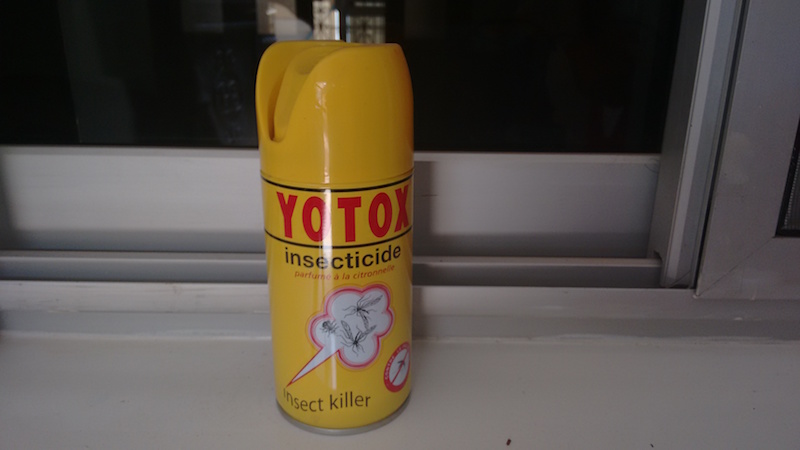
bug spray for non-English speakers…

… or those who don’t mind not-so-subtle reminders that what is toxic to insects is also toxic to you.

my mystery malady

This past Wednesday, I woke up feeling exhausted but otherwise fine. About an hour after eating breakfast, a dull sense of weakness and malaise began creeping over me and I had to lie back down. By the end of the next hour, I was unable to sit up, paralyzed by bodily fatigue. I had stitches of pain and muscle aches in my legs and sides and neck. I couldn’t find a comfortable position and every time I moved I moaned. I was chilly and sweaty at the same time.

I didn’t want to jump to malarial conclusions and I also didn’t want to go to the doctor without a very good reason, so I tried to wait it out, but by 7pm it was clear it was getting worse instead of better. I had gotten nauseous and head-achey, my aches had turned into pronounced pains, and I could barely crawl out of bed let alone stand up straight.

I hobbled with Mamie to the pharmacy next door where they pronounced their prognosis soon after my arrival: “un petit palu,” a mild case of malaria. I told them I take doxycycline every day as a prophylactic and they mimed the pill going in one ear and out the other. They gave me a fizzy paracetamol tablet to reduce my fever and told me to get to the doctor stat.

So we headed to the emergency room (salle d’urgence) of the hospital downtown, whereupon I began an epic journey / vocabulary lesson. Continue reading

sibling rivalry

15999622622_d235e58046_z.jpg

Every once in a while, I come home to discover a new person or two at the dinner table and find out that they’ll be staying for a few weeks. So far they have been a Cape Verdean public health Ph.D. candidate doing research in Dakar, a pair of American students at the language center where I took French classes, and a set of Senegalese doctors who were in town for some sort of very short residency.

The Cape Verdean came first. The night he arrived, we all made sparkling conversation around the table, and I was surprisingly chatty in French. I had one of those nights in which I didn’t have to search for the words; they just came to me. I was conjugating (mostly) correctly, my subjects were agreeing with my verbs, I was cracking jokes, and I understood or could infer the meaning of everything that was said.

I was feeling great… until my “host mom” looked at the Cape Verdean guy and complimented him effusively, “You speak French very well.” (Cape Verde’s official language is Portugese.) Her gaze was ever so slightly askew, so that I might have convinced myself she was talking to me instead of to him, had my host sister not noticed the “what about me?” look on my face and piped up, “Ruth speaks French well, too.” My host mom glanced at me and without realizing the blow she was dealing, she conceded, “Ruth’s French is improving.” BURN.

And that’s how it came to pass that I became insanely jealous of a random Cape Verdean dude, and wouldn’t stop ruminating on how annoying it is that he pronounces his qu’s like kweh instead of keh.

With the American students, rising college seniors, I got even more ridiculous. One didn’t speak any French and so I loved her. But the other claimed to be “almost fluent,” and every time she opened her mouth I found myself hoping she’d trip up. Meanwhile, I would pipe up needlessly in dinner table conversation just to prove that I could speak French, too. I had fifteen years on this women and yet despite her being nothing but kind to me, I was threatened and competitive. My four year-old niece behaves more maturely with her one year-old brother.

The saddest part is, if I could only get out of my own way, I could learn a thing or two from this woman – not about French but about life. After a week in the house with her, I realized that her French is “almost fluent,” the way mine is – that is to say, not at all. And yet, her confidence made it easier not only for her to speak but also to not suffer over it the way I do.

I need to chill out with a. the thought that I’m on some sort of French fluency time table and running way behind schedule, and b. the belief that every time I open my mouth to speak French, my value as a human being is on the line. It’s really not that big a deal. No one cares. I speak how I speak, and it’s fine.

The US military often sends service members to the language center for French and cultural training, and in a couple of days, two of their guys are coming for a few weeks’ stay. I am hoping that I will successfully dial down my competitive streak during their time here. (Well, really I’m hoping that they’ll suck at French so that I won’t feel any competition to begin with.)

[Photo: Mr. T HK]