solo in Paris – or anywhere really

strolling couple in paris

My favorite thing is to wander aimlessly around a densely packed city and take in the sights. That’s basically all I did in Buenos Aires from early in the morning til the wee hours of night: walk and gawk, walk and gawk, stop to sit in a park, walk and gawk, stop to eat steak (always, steak), walk and gawk, walk and gawk. I must have covered a forty square mile area by foot and every single block had something to be in awe of, whether animal, vegetable or mineral.

Apparently the French have a word for people like me: flâneur, or stroller. Stephanie Rosenbloom wrote a piece for this week’s Times travel section about strolling Paris on her own, and it perfectly captures the magic of solo travel. The way that being alone enhances the senses and imbues every experience with both grounding stillness and skin-prickling energy.

Paris, she convincingly writes, is a city that “deeply rewards the solo traveler”:

In a city that has been perfecting beauty since the reign of Napoleon III, there are innumerable sensual details — patterns, textures, colors, sounds — that can be diluted, even missed, when chattering with someone or collaborating on an itinerary. Alone one becomes acutely aware of the hollow clack of pétanque balls in a park; the patina of Maillol’s bronze “Baigneuse se Coiffant” that makes her look wet even on a cloudless day in the Tuileries; how each of the empty wine bottles beside sidewalk recycling bins is the embodiment of someone’s good time.

I have only spent a few days in Paris and that was years ago – but I remember it as gray, snobby and overrated. I’ve never felt the need to return until I read this article, which had me wanting to jump on the next plane. Instead I practiced my flânerie / joggerie along the Hudson River on a drop-dead gorgeous New York City day and was thankful to be living in the walkingest city in the world.

(Photo: I took this picture when I visited Paris in 2000. Everything about this elderly couple, from their classic dress, to their slow unhurried stroll, to their arm-in-arm charm, felt perfectly suited to the city.)

l’amour est fou

useful romantic expressions in French

Saw this list of French phrases that are “useful for romantic situations” on Pinterest today, pinned from this apropos Tumblr. I love how it starts out syrupy sweet but midway through the other side of love starts peeking through – the “Are you crazy?”s and the “Leave me alone!”s.

Funny because my biggest love / hate relationship at the moment seems to be with Duolingo. When I’m not forcing myself to do it, it’s the most breezy and satisfying thing ever, but when I’m just trying to get through it so I can move on to other things, I feel nothing but resentment. As though Duolingo is the cause of my angst instead of my own tendency towards OCD. Anyway, I was upstate with friends this past weekend and ruined my 53-day streak on Sunday, which made me really sad. Ah well, c’est la vie.

duolingo doldrums

I have seen this little guy a few too many times this week.

Duolingo out of hears owl screen

Over it.

The Duolingo owl, the Twitter fail whale – what is it with cute animals bearing bad digital news?

investing in experiences

piggy bank

I love this post by Design Sponge’s Amy Azzarito, about rechanneling her money from “things” into “experiences.” She’s committed to that practice in theory, but as she points out, “it’s easier to say that you’re going to stop buying things (and invest in experiences instead) than it is to do it.” Especially in New York City, I would add.

It’s really hard to keep from buying stuff I can technically afford – whether a pair of shoes I really want or the new mattress I actually really need – when the alternatives seem to be spending the money on some other thing instead, using it for a fairly small beans experience, or putting it away towards a far-into-the-future goal that is too lofty and nebulous to feel real (i.e. saving enough to ever retire).

It became easier for Amy when she earmarked that money towards a specific, medium-term “experience” goal instead – in her case (and mine), travel:

One of the best things that helped me through my detox diet was deciding what my next travel experience (my ultimate goal) was going to be. Looking at travel books (which I checked out from the library) and pricing out trip options seriously helped curb spending. Those Vans shoes basically equaled a night in a hotel and once I started looking at things through my travel goggles, I was much less likely to even consider spending the money on them.

“Travel goggles” is an apt term for what happens when you commit to a plan that requires lots of vision and tenacity and temptation resistance but that makes you super excited and motivated, too. Ever since I decided to do a self-styled study abroad sabbatical – and priced out how much it will cost – I’ve found it easier to pass up non-essential purchases. I know that to make my trip a reality I’ll have to aggressively reroute all my disposable income – for two years – towards that dream. God knows I won’t be able to stay the course for a third year, so it’s really important that I don’t cheat on my saving commitment.

That means I’ll be whipping out my travel goggles often – whenever I am staring down a pair of miraculously comfortable heels, or burning soup in my paltry excuse for a saucepan, or feeling sad about the state of my apartment’s furnishings. Another night (or 700) on my glorified futon now means another night in West Africa later.

P.S. Here’s another one of Amy’s posts – about facing the fear of learning a second language – that seemed written just for me, apart from the fact that I’m sure a million people can relate to it.

(Photo: Philip Brewer)

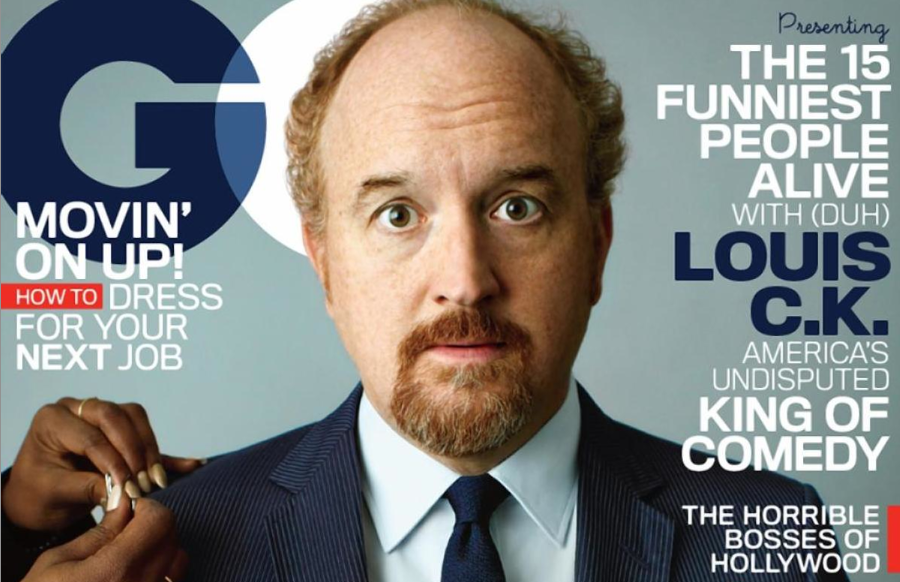
(get over the) hump-day inspiration: louis c.k.

Louis C.K. GQ cover

(Photo: Peggy Sirota/GQ)

Words of wisdom from Louis C.K. in the new issue of GQ:

“You’ve got to embrace discomfort,” he said. “It’s the only way you can put yourself in situations where you can learn, and the only way you can keep your senses fresh once you’re there.”

This needs to be my mantra as I psych myself up to go back to French conversation Meetups for the first time in more than a year. I find them so awkward and deflating. My everyday self-consciousness balloons seven-fold at the prospect of not understanding anyone and/or butchering such a melodic language. And it’s exhaustingly hard work to catch every word the person speaking to you is saying and to formulate a response that both makes sense and talks around the words you don’t know. Without fail, I leave feeling like Sisyphus instead of patting myself on the back for taking the baby steps that will eventually add up to progress.

But! Meetups are the best, cheapest way available to me now to get over the listening and speaking hump and the more I do, the easier it’ll be when I go abroad for full-on immersion.

One of the reasons I started this blog, actually, was to force me to go to Meetups so I’d have something to write about.

I’m giving myself the month of May to dive back in. With this blog as my witness!

P.S. This week’s inspirational quote is pretty much a reframed version of last week’s quote. I’m a one-trick quote pony I guess.

wanderlust wish list

Dakar, Senegal

(Dakar photo: André Thiel)

Yesterday was a day of bad news and angst, and I really need something to lift my spirits today. Strange as it may seem to non-A-types, sometimes all it takes is the exercise of making a list to give me a little pick-me-up. Ordering the bullet points of my life and aspirations on one neat, scannable page is deeply satisfying. And when I create a wish list specifically, it lets me visualize everything I aspire to all at once. Which makes me happy.

So, today’s list of choice: the top 10 places I would like to visit.

1. Senegal

Dakar, Senegal

(Photo: Kalyan Neelamraju)

I have wanted to go since I first learned about this country in eighth grade French. Something about the culture and climate of Francophone West Africa calls to me, and the prospect of going to Dakar has been the carrot on a stick to keep me interested in French for more than 20 years now. I haven’t yet made it out there because I only ever had one or two of the requirements for the trip concurrently: enough time off, enough money to spend, the right travel partner, and/or the right frame of mind to visit alone. But mark my words – conditions are ripening and I’m committing to make 2016 my year!

2. Patagonia

Patagonia

(Photo: Chris Ford)

I saw a photo like the one above, and I was sold.

3. Cuba

Havana, Cuba

(Photo: Nathan Laurell)

For many reasons – cultural, architectural, temporal, geographical, linguistic.

4. Ukraine (my mother’s mother’s motherland), along with St. Petersburg and Moscow – once things simmer down…

Ukraine

(Photo: Peter Fenďa)

5. Azerbaijan

Azerbaijan

(Photo: Pierre)

Don’t know why exactly. Maybe something about East meeting West appeals to me. And Azerbaijan is one of the most beautiful names I’ve ever heard. Which is a terrible reason to visit a country, but sometimes a place just gets into your head for all the wrong reasons and then sticks around.

6. Charleston, South Carolina and Savannah and Athens, Georgia

Savannah, Georgia

(Photo: Jen Goellnitz)

I would eventually like to visit all 50 states and Georgia is the only one on the Eastern seaboard I haven’t been to (unless you count the Atlanta airport). Charleston and Savannah are supposed to be charming Southern cities and Athens sounds like a cute college town and I would love to road trip between them all.

7. Australia and New Zealand

near Perth, Australia

(Photo: Kenny Teo)

I can’t get more specific because I want to see all of it, from Sydney to Melbourne to the Outback to the West, to Aukland to Wellington to Christchurch to the mountains in between. Which means I will probably never see any of it. My fatal flaw is I get too ambitious and then end up doing nothing when I realize I can’t do everything.

8. Kenya and Tanzania

Tanzania

(Photo: David Berkowitz)

Again, overambitious. I want to see Kilimanjaro and the Serengeti and Masai Mara park and Lake Victoria and Nairobi and Zanzibar. This is actually a scaled down version of my original plan, which had been to visit Mozambique in the same trip.

9. Norway and Sweden

Lofoten Islands, Norway

(Photo: Henrik Johansson)

For midnight sun and the fjords. I was thisclose to using my miles on a Scandinavia vacation a couple of years ago but thankfully, I looked up the prices for hostels first and was rudely awakened to the fact that Norway has one of the highest costs of living in the world. Hostels were the price of hotels. So this one will probably stay on the wish list awhile.

10. Mexico City

Mexico City

(Photo: Boris G.)

Mexico’s got thousands of years of history and I’ve only ever been to the tourist strip in Tijuana. I need to cleanse my brain’s Mexico palate with something more representative.

Honorable mentions: Mali (not the best time to visit…), South Africa, South Korea, Montana and Wyoming.

Ahhh, that was fun. Which places are on your wish list?

Si se puede! Jordan Helton edition

NanxunWestLake

‘Si se puede’ is a series (God willing) in which I grill talk to people who have successfully learned a second language in their 20’s, 30’s or beyond, to find out how they did it. I need proof that it’s never too late to learn a foreign language!

First up is my colleague, Jordan Helton, a whip-smart, wry and upbeat journalist from a tiny town in Oklahoma (1,800 people!). After graduating from college in Illinois, she moved to China and spent the next eleven months teaching English to K-12 students in Hangzhou, an hour and a half outside Shanghai.

Why China?

I knew that I wanted to go abroad right after school. I had never been to a foreign country, never even been to Canada. I wanted to work in some international aid field so I thought that would be important. I took three years of Russian in college, but I didn’t really want to go to Russia. So I started looking for ESL teacher jobs. If you have ever looked for a job as an English teacher abroad – it’s so easy to be hired in China. There are hundreds of job openings to teach English to kids.

What was your comfort level with Chinese when you first got there? 

I did not speak a word of Chinese.

How did you feel about that? Were you scared?

I just assumed everything would work out. Learning languages is one of my favorite things to do, just period. It makes my brain hurt in a good way. Learning languages is really difficult for me, but it’s a type of mental exercise that I don’t necessarily get in other parts of my day.

Did you set a goal of how much or how quickly you wanted to learn?

It was such a daunting task when I first got there. I knew that I wanted to speak the language but my first goal was just to be able to feel like I could survive on my own – that I could get to my house, if I got lost I could ask for directions; that I could go to the cafe and order a coffee. I need to count to ten. I need to be able to buy something at the store and understand the amount that he’s telling me to pay. And then once I became comfortable with that it was wanting to be able to have a conversation on a particular topic. And then it was, Christmas is coming up, I want to be able to discuss Christmas with the kids that I teach. So I think that I never had a long-term goal; I broke it up into short goals that I could meet and feel happy and accomplished about.

Christmas in China

So what was your process for learning the language?

As soon as I got there I started looking for a private language teacher. With Chinese you’re not just learning one language; you’re learning two different languages. You’re learning spoken and hearing and you’re also learning how to recognize on sight an image and know what that stands for. And so, when I first got there, learning characters and reading was extremely difficult and I really didn’t get into characters until about three months in. So I started out, I met with my private teacher twice a week for two hours each time. For the first three months we just focused on speaking and listening. For the first half of the lesson, we would go over textbook work, and then the second hour we would try to have a conversation, as much as we could. And then after three months I finished one textbook and I got to level two, and that was all in characters. I tried to learn ten new characters a week. I was living with someone at the time who was also learning Mandarin with the same teacher, so we would study together for a half hour every day.

And I had a lot of Chinese friends. My Chinese teacher was only a year older than I was and we’d often hang out and try to speak Mandarin as much as possible. I was really good friends with the teaching assistants at our school who were Chinese students studying English, so I spoke Chinese with them as much as possible, too.
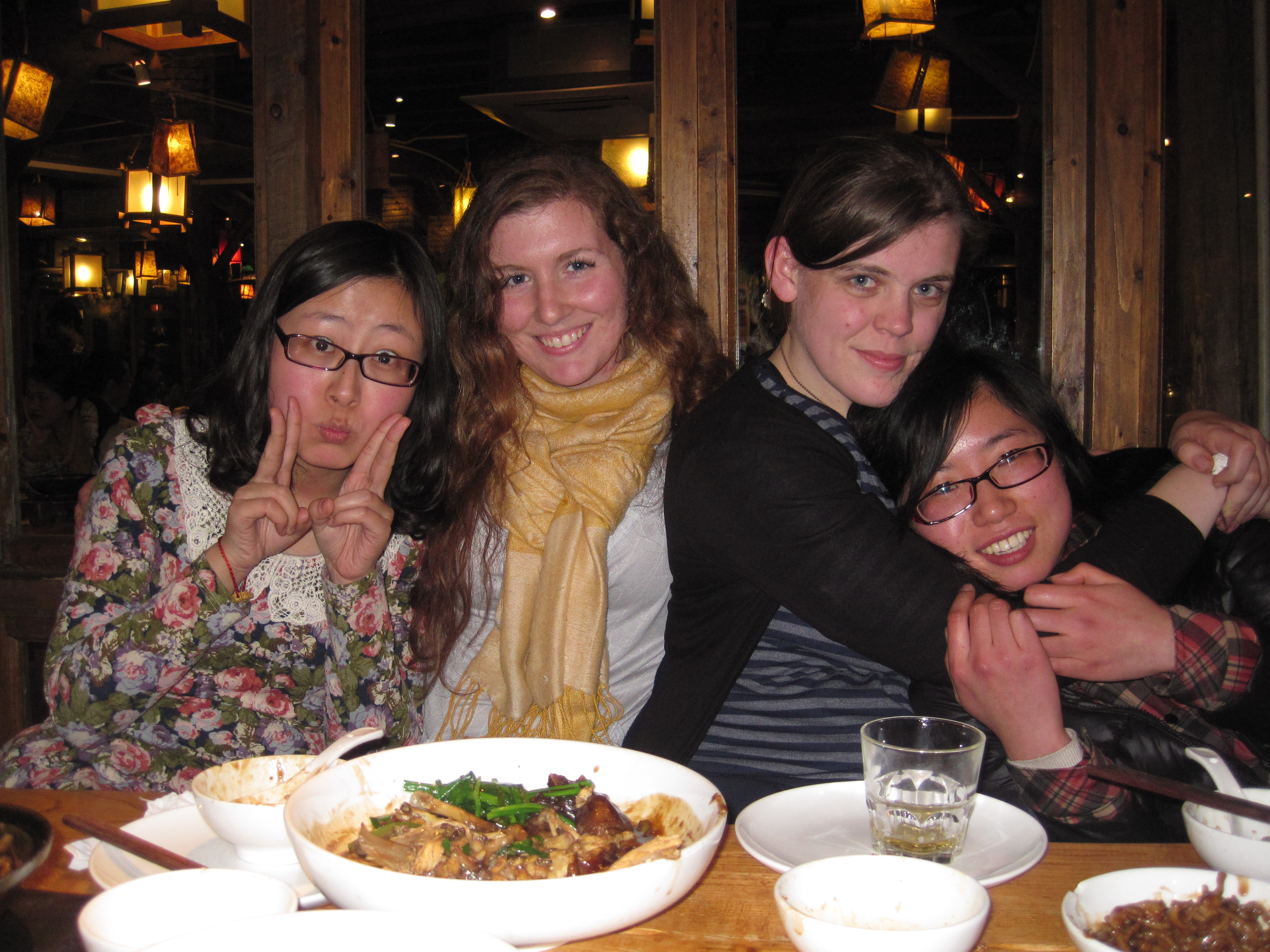
Jordan & friends

Did you have an “a-ha moment” when you realized you had gotten over the hump and could speak the language?

I don’t know if this was a turning point but it was definitely something I took a lot of pride in personally because it was the first time I really had a long conversation about a complex topic that was also a joking interaction where I understand the humor. I was taking a cab to the train station and just having this amazing conversation with the cab driver. The conversation turned to politics and he was like, “What do you think of Obama?” We were having this back and forth, and then the cab driver was like, “Oh, I hate Obama. He’s not a good president. A good president, that’s Richard Nixon.” And I was trying to explain to him, “In the U.S., he doesn’t have the greatest reputation, actually.” That was probably five months in. Whereas five months before I couldn’t even say hello. But it was just being immersed in the culture and taking the time to study every day, having to use the language every day. It wasn’t a choice for me; I had to use it.

Huangshan

[That’s Jordan in the blue coat, above.]

How was learning Chinese versus learning Russian?

Russian was the sort of language class that you had every day for an hour, five days a week. I took that for three years, with an hour of homework every night, trying to watch Russian language movies, having little tea times that our teachers set up to speak. But even after three years I felt that my proficiency then was still not as high as one year living in China hearing it every day and being forced to speak it every day. It’s hard to overstate how big of a difference being immersed in both the language and the culture makes versus a sterile academic environment.

Just for fun… what was the biggest language faux pas you made? 

I would have the perfect example in Russian. Just based on where you put the accent in a word, like “ya pishu” means “I write.” “Ya pishu” means “I piss.” I’ve done that before. In China, nothing comes to mind. My Mandarin, horrible though I know it was, was always received with the most patience and just like, gleefulness, of the person, knowing that a foreigner was trying to learn. So I think that if I ever did make a big faux pas, it wouldn’t have been a big deal. Everyone who I interacted with was happy to listen to me just brutalize their language.

Magic Bell at Pagoda in Xi'an

Now that you’re back in the States, how do you maintain the proficiency you’ve achieved?

Here in the U.S. I feel like I have to push myself to find those opportunities to keep working. A friend recommended Conversation Exchange, a website to find language exchange partners. It’s like online dating but for language learners. So I used to meet every Sunday with a language exchange partner. I actually had two, secretly – but I never told the other one that I had another person I was speaking Chinese with because I felt like I was cheating on them. You know in those sitcoms when people schedule a date right after a date and everything goes wrong and in the end it’s such a stressful experience? That’s how it was with me and my language partners. I tried really hard so that they never met each other. So I’d meet one at Union Square and then I’d travel up to Bryant Park to meet the other one. Four hours every Sunday.

Do you have any words of wisdom for other people trying to learn another language? 

I think being passionate about the language that you choose is extremely important, otherwise you’ll just float away. Know why you’re learning the language before you start, to keep you committed.

Thanks, Jordan, for indulging me in this little exercise! Inspiring evidence that even the hardest of languages can be conquered when you are a fearless badass and put in the time and effort.


have a good weekend!

Arles, France

What are you up to this weekend? I will be continuing my Duolingo streak (days 46 and 47, I think). I’m about two-thirds of the way through the French version and at the rate I’m going I hope to be done by the end of next week. I’ll also be fitting in an episode or two of Destinos, a telenovela for Spanish learners that is extremely retro and extremely watchable for reasons I will get into some other time.

And I will be doing normal-person things, too: a hockey game viewing, a good friend’s birthday dinner, a documentary shorts screening, a run through the park. (That’s the plan, at least. I have a tendency to get over-ambitious…)

Til Monday! In the meantime, for your clicking pleasure here are some interesting and relevant things I read this week:

The benefits of learning a language later in life

Tips to stay motivated

The world’s best destinations for solo travel (Apparently Paris has “fun speed-dating styled language improvement events.”)

Lyon vs. Paris

Three ways to combat language-learner’s envy. 

The updated Duolingo app has a “duel” feature.

And, sadly, it’s not actually true that France banned work emails after 6pm.

(Photo of Arles, for your weekend daydreaming: Salva Barbera)

foreign food festival friday

Because food is culture, and culture is its own important language.

First up, pan de queso aka chipás! Or: cheese bread for the gluten-free (a group of which I am, sadly, a member).

pan de queso aka cheese bread

These little buns are more commonly known as pão de queijo and most people think of them as Brazilian but I first encountered them on the Argentinian side of the Argentina/Brazil border when I was visiting Iguazu Falls (the most jaw-droppingly awe-inspiring place I’ve ever been, by the way – you won’t be convinced from the pictures – you just have to see it to believe it).

Sadly, I didn’t try chipás at the time even though they were touted as “traditional Misiones food: tapioca flour cheese bread” on the little English sign in the hotel’s breakfast buffet. I couldn’t be sure they were 100% gluten-free without asking someone to tell me exactly what was in them, and in order to do that and to understand the response I would have had to speak way more Spanish. Yet another reason why it is useful to learn other languages – to avoid accidental ingestion of substances toxic to your body.

When I got home I did a bunch of googling and confirmed they were indeed gluten free and felt really sad. I had tragically foregone alfajores because of my condition but I hadn’t needed to miss out on cheese bread.

So I decided to make them at home, using this recipe from the Kitchn. If you have given up gluten consumption I think you’ll find, as I did, that these little cheese buns are a delicious consolation prize. If you’re used to eating whatever kind of bread you want, you may not see what the big deal is. As for me, I’ve now made them three times, dumping in more and more cheese with every batch. (I wouldn’t recommend this – last time got a little out of hand and now I’m going back to the original recipe.)

Happy Friday!

(Photo: Rodrigo Gianesi)

the best of words, the worst of words: maracuyá and chancleta

This is the first in – I hope – a series in which I ask Spanish and French-speaking strangers to write down their favorite and least favorite words in their language and then tell me – in Spanish or French – why they chose them. A ploy for me to learn new vocabulary and force myself to get some conversational practice. Full disclosure: this first time we talked in English because I am still muy patético at speaking Spanish. But – one day!

Félix is a Colombian linguist who would rather be behind the camera than in front of it. Hence you’ll have to create your own mental picture of him through his disembodied hands, his remarkably varied handwriting and his interesting word choice. 🙂

Félix’s favorite word:

photo (1)

Why? “Because it has a very flowing sound and it has an accent at the end and I like agudas, where the stress is in the last syllable. And the fruit itself is delicious.”

I googled it: agudas = oxytones, if you’re interested.

Félix’s least favorite word:

photo (2)

“It is onomonopoetic. I don’t like it because of the sound. The combination of strong consonants and open vowels.”

Spoken like a true linguist.