hair today, gone tomorrow

demi_moore_ghost.jpg

Apologies for the ridiculous post title but it’s just too apropos, considering that the thing making me most nervous right now is not my impending departure from New York for parts unknown, but rather my hair’s impending departure from my head to the garbage.

Today I stopped in to see a fancy stylist for a consultation / therapy session, which I insisted on having before confirming the actual haircut appointment. I needed to get her assurance that my face can handle what I have in mind… which is Demi Moore in Ghost but with heavier 1960s sideburns. (The heart wants what it wants.)

I haven’t had short hair since 1987, when I was forced into a unibrow-framing pixie-meets-mullet just before starting third grade. As I confessed to the stylist (she was very patient), I still remember the painful walk through the athletic field to the blacktop on the first day of school, and the trauma of having nowhere to hide when I lined up for the morning bell outside my new classroom. I can still feel the burn of the cheeky grin from the boy who had harbored a crush on me the year before. With three decades’ worth of retrospect I can see that he may have been smiling out of adoration rather than mockery, but at the time all I could think was that I looked like a hideous boy and that my quest for popularity was now doomed.

Well, I don’t particularly like long hair anymore and for years I’ve been toying with the idea of going super-short. The fear of reliving my third grade shame has always held me back, but now that I’m leaving the country in a few weeks, I see an opening. After the stylist reassured me seven different ways that I’d look just fine channeling early 90s Demi Moore, I beat back a rush of serious nausea and booked my haircut appointment for the day before I leave for Senegal. If my hair turns out terribly, I’ll just have to avoid people I know for 24 hours, and then forgiving anonymity will be mine for as long as it takes to grow it all back.


places to go in 2016

Brno.jpg

The New York Times recently came out with its annual “places to go” list and I am happy to report that I am one step ahead of the curve, having made it to their first place, tenth place and 37th place destinations in 2015. But I don’t think that I – or anyone – should give much credence to the Times, considering that my father’s birthplace made it onto the list this year. HAHAHAHAHA. If you know Brno, you know that this is as inadvertently self-satirical as the Sunday Styles section.

I wrote a whole bunch of snark just now and then deleted it all. Who am I to judge a city in which I have never lived? But then again we are talking about where to visit, not where to live… and having visited Brno three times and each time having wished that my dad came from Prague – I’d say, you can skip it.

(I feel really disloyal writing this in public, like the Brno Chamber of Commerce is going to blacklist me or something…To be fair, Brno has a fun-to-say name and a neat castle-on-a-hill and a random stuffed crocodile hanging from the ceiling of town hall. And I wholeheartedly love the country in which it resides.)

[Photo: Sergey Galyonkin]

I’m one of those people now

tantrum.jpg

This past Saturday at about 5:30pm, I got on the subway at Union Square with the intention of stopping by my apartment to do some work before heading back downtown to Murray Hill for an 8pm dinner date.

On a normal day, each commute would have taken no more than 45 minutes, leaving me with an hour to spend at home. On this particular day, train delays and reroutings conspired to keep me underground for two hours and transport me, very much without my knowledge or consent, all the way to the Bronx – but never to my actual home. At some point during my subterranean wanderings I realized I had run out of time even to run upstairs to change into a warmer coat and come back down again, so I abandoned the plan and switched to the southbound platform.

20+ miles, four subway lines, and zero actual accomplishments later (except, perhaps, exploring new frontiers of bladder control), I got off the train at Penn Station and spent ten minutes lost in a labyrinth of temporary drywall passageways. When I finally found the stairs to get above-ground, I stomped up each step like a petulant four year-old while seething, “Get me out of this city!” (Plus curses.) Walking to my friend’s house, I lowed at a flock of slow-moving women near Macy’s, “Pleaaaaassse moooooove!” and at the next crosswalk I snapped at a daydreaming pedestrian, “Watch it!” and stretched out my arms to indicate that I would shove him out of the way if he didn’t move on his own. (He did.)

I was in rare form, but instead of quickly calming down and recoiling from my behavior in horror and embarrassment, I just thought, yep, I’m way past due to take a break from New York City.

Then I arrived at my French friend’s house, where a raclette spread and the company of delightful people was waiting, and all became right with the world again. (Until it was time to take the subway back home.)

raclette friends.JPG

P.S. The first two things I will acquire when once more I have a stable home are an espresso machine and a raclette maker. I’ll be sleeping on an air mattress but eating well!

[Drawing: Will Laren]

Well this was unexpected

unexpected.jpg

So apparently my golden ticket is not so golden. This morning I went to the Senegalese consulate to inquire about visas, since they are not required for visits of fewer than 90 days but I may want to stay beyond that.

It was quite a surprise to be told that the visa is the least of my problems. Once in Senegal I can visit the immigration office at any time to apply for a visa… but I will not be allowed in the country – or for that matter, on the plane – if I show up to the airport without a return ticket.

I spent about twenty minutes trying unsuccessfully to ascertain whether “return” meant going back to the country of origin, or onward travel to any destination outside of Senegal. The two people I spoke with consulted about the nuances of this question and I could not follow along in the least (nor could they give me a firm answer in English). At first I thought they must be speaking Wolof, but I kept hearing words that, if pronounced entirely differently, would have sounded like French to me. This led me to wonder, not for the first time, whether Senegal is actually the best place for an American to learn French. But I’ll table that question for now in favor of the bigger issue.

As it turns out, you can’t just buy a one-way ticket somewhere and promise them at passport control that you will definitely leave within the time allotted to you. I feel pretty naive for making this little faux pas, but I’m not entirely sure how best to correct it, since I have no idea when I want to leave Senegal nor where I want to go next. I don’t want to book an arbitrary placeholder return ticket and change the date and/or destination later, because that will cost money that I haven’t budgeted for this particular use. But it looks like that’s exactly what I’m going to have to do.

Looking forward to spending the next eight hundred hours on the phone with United…

[Photo: Eva Holm]

step by step

small dog steps.jpg

I once tried exposure treatment to overcome an increasingly debilitating cockroach phobia. The therapist had me create a fear hierarchy – a list that broke my phobia down into discrete and sequential parts, from the thing that frightened and disgusted me least (staring at a roach in an enclosed jar) to the thing that I’d literally rather die than experience (having a cockroach in my mouth, which, granted, is no one’s idea of a good time). Then, with the therapist guiding me, I moved step by step up the fear hierarchy, sticking with each item until the concomitant fear and disgust subsided enough to move on to the next item.*

Unfortunately, I never fully beat my phobia because I ran out of time and, let’s face it, the will to put a cockroach in my mouth. But I did let one crawl all over me (albeit slowly, because I had dropped it about six times first) while another one raced around the room.

That was a very long way of getting to the point of this post: without realizing it, I’ve been moving up the rungs of my travel fear hierarchy.

It began in 2010, when I went to Tunisia for work. This was the first time I had to use bottled water and avoid fresh food, which freaked me out a bit. And when I had a few days on my own to explore, I opted to glom on to my colleagues’ plans, and then to meet up with a friend who flew in to join me.

A couple of years later, I did my first truly solo trip to a new place, but an easy one – Providence, Rhode Island. It felt strange but awesome to book a hotel room all for myself and to wander around the city with no real reason to be there except to see it.

The next year I visited a friend in Portland before riding the train up the coast to Vancouver. It was the first time I left the country by myself without plans to join anyone else – whether friends, colleagues, or other people in a study program. But everybody spoke English and the only culture shock I experienced was wondering why they liked ketchup-flavored potato chips so much.

A year after that was the big leap. I booked a two-week trip to Argentina and opted for a hostless AirBnB in Buenos Aires. At that point, I spoke only the Spanish I had crammed into my head during two weeks of Duolingo practice – which is to say, not much. I knew not a person, no one seemed to speak English, and though I thought of South America as an exotic wonderland, I also thought of it as the place in which I might be axe-murdered (for no particular reason except that I was a woman alone). My first night, I scurried home right after dark and felt so lonely that I watched “Keeping Up with the Kardashians” for company. By night three, I was staying out til four a.m. with people I met at dinner, and pinching myself at how fortunate I was to be born into a time and place and circumstances that allowed me to do my own thing. For 99% of history and for a large portion of women alive today, that is not the case.

And now I’ve just returned from Mexico City and Elsewhere, the most challenging solo travel I’ve done so far. Mostly because Elsewhere is not set up for someone like me to visit, in more than a few ways. I would describe it as a working vacation, the equivalent of hiking the backcountry of Yosemite. Super fun, super satisfying, but super tough.

Which has set me up perfectly for the climb to the last rung on the fear hierarchy – francophone West Africa, alone, long-term. All the previous steps prepared me, little by little, to sit with my fears of this next trip without letting them overwhelm me. In a way, the fear is invigorating. If it were easy, I wouldn’t be as attracted to it.

*I’m pretty sure that was the first time I have ever used the word ‘concomitant’ in a sentence and I am really proud of myself.

[Photo: Les Chatfield]

I’ve got a golden ticket, I’ve got a golden ticket!

DAKAR.jpg

People. I just booked my ticket to Dakar. I wanted to lock it in before the dust settled on my Elsewhere trip and the paralysis and despair of unemployment (which started this evening) wrapped me in its death-grip. I also thought, wouldn’t it be nice to go into the new year with something to definitively, concretely look forward to and plan for? And why wait? The longer I put it off, the more opportunity I had to start squirming.

So I’m flying to Dakar on Valentine’s Day, which seems appropriate given how I’ve loved Senegal from afar since the age of 14. The amazing thing about this trip is that while I panicked two years ago when I purchased a solo ticket to Argentina (13 days long) and became mildly anxious when I booked a 1-person trip to Mexico City and Elsewhere (11 days long), I barely batted an eyelash of anxiety when I confirmed this ticket (one-way, i.e. unlimited-days long). Practice makes perfect, I guess.

Now I am heading downtown to raise a glass and toast not only the new year but also the next adventure, 22 years in the making.

Happy new year! Or, rather, bonne année et bonne santé, from someone who will be speaking nothing but French in a matter of weeks…

Coming out of the woodwork

woman_on_map.jpgIt seems that the more boldly you go in the direction of your dreams, the more readily you find kindred spirits going boldly in the direction of their own very similar dreams.


It started two years ago when I traveled to Argentina for my first solo adventure abroad (apart from Vancouver the year before, which barely counts). I met a 20-something Korean woman who had been backpacking alone for four months across South America even though she spoke maybe 40 words of Spanish and even fewer of English. I sat next to her on the bus back to the hotels from the Argentine side of Iguazu Falls one night, and then ran into her at the entrance of the Brazilian side early the next morning. We walked around the falls together, and though we understood next to nothing of each other, her bad-assness translated perfectly.

A few months ago at a Speakeasy event I met a French woman in her fifties who was in the midst of long-term travel. She is the only person I have ever met who has taken a cargo ship to get where she was going, and she did it by herself. I asked her all about it because I would love, love, love to do a leg of my (still-nebulous) journey via one of those ships but am just a little wary of what that would entail. She assured me it was safe, clean, fascinating, generally awesome. More inspiration in the bank.

In Mexico City two weeks ago, I hit it big. At breakfast on the last day of my trip, I met a Dutch man whose adventure started twenty-something years before when he moved to Sweden after studying Swedish in school. He just loved the idea of Sweden for some reason, much as I love the idea of Senegal without really being able to say why. After something like twelve years there he quit his job as a translator to travel through South America and Asia, but he ended up staying in Buenos Aires for almost three years because he loved it so much. (Much as I fell head over heels for Argentina.) At some point, his former company called to offer him translating work that he could do via telecommuting, and he realized he could travel at the same time. So he’s been a veritable nomad for twelve years. He speaks seven languages, several of which he learned in his thirties, and he did it via self-teaching and immersion rather than classes. I practically bowed down to this man for offering living proof that it could be done.

Then I returned to work and found out that it was a colleague’s last day. I hadn’t talked to her much before but we started a conversation and learned that we are the same age, have trained in similar fields, and are both about to take off on a self-financed trip to Africa to finally do what we’ve been meaning to do for years. She plans to head to Tanzania in January to document the situation for Burundians in refugee camps. I told her I’d see her there – since, you know, we’d be nearly 6,000 miles from each other but we’d be on the same continent, so of course I’d come to visit.

Because that’s how you’ve got to think when you’re thinking big.

[Photo: Kate Ter Haar]

my new smartphone rules

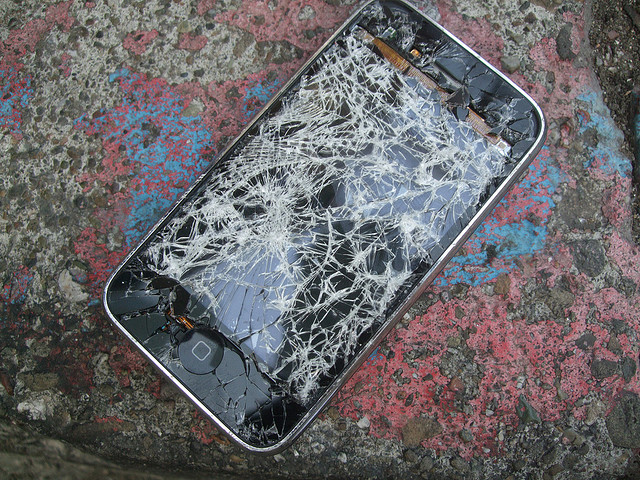
broken_iphone.jpg

I am something of a Luddite. A hypocritical one, as I rely on modern technology to do my work (documentary and news production), but a Luddite nevertheless. I don’t embrace machines that make life easier unless they free up my time in the world (dishwashers!) instead of taking time away from it (stationary bikes).

Even though it is a supremely useful device, I resisted getting a smartphone for years because I didn’t want to turn into a person who was more engaged with my phone than with everything and everyone around me. I succumbed a couple of years ago when I realized that without one, I was at a distinct disadvantage work-wise. Knowing that I tend towards an obsessive personality, I set rules for myself to try to limit the extent to which the smartphone could suck up my presence and swallow my soul. But as expected, I broke every single one, and little by little I became a smartphone brat like the rest of them.

There’s nothing like seeing how people live in a country with hardly any computers or smartphones to recognize that I am in my terrible twos of iPhone ownership, and if I don’t impose some mom-like discipline on myself, I’ll turn into a complete and utter wasteland. So it was two weeks ago on the plane home from this place – where it was impossible to use my phone as anything other than an alarm clock and camera, where I did not go online once, and where the digital age was limited to televisions and flip phones – that I decided to take advantage of the momentum and reset myself with some stringent smartphone and Internet rules:

– phone /Skype conversations only at home, at work, or parked somewhere. No walk-and-talks.

– no walking and texting, ever.

– text checks 3x a day max, unless I’m in conversation with someone and/or time is of the essence.

– email checks 3X a day max except work emails while at work.

– change notification settings so I don’t get any phone alerts when texts or emails arrive.

– use apps only for “necessities,” meaning: navigation, weather report, my schedule, checking on important work-related stuff, writing notes, accessing my bank accounts, getting the news, mapping my runs. (I know I am pushing the definition of necessity.)

– use social media only for work, except Facebook no more than 1X per week and for no more than five minutes at a time.

– no mindless Internet browsing – must have an objective in mind when online. Once that objective is met, get. the. !@#%*$. off.

Good rules, no? I’m going to see how it goes and reassess in a few weeks.

Switching cultural languages

roses_in_the_trash.jpg

When I first read the sign in the bathroom that asked in broken English for all paper to be thrown in the trash and not in the toilet, I assumed it was translated incorrectly. Because how on earth could people deposit their soiled toilet paper in a can and leave it there, in the house? I had bucket flushed my way through the Philippines, but this practice struck me as way more unsettling.

After seeing significantly placed trash cans and/or strongly worded signs in every bathroom in the country except in the fanciest hotels, throwing my dirty paper in the trash became a thoughtless fact of life. I got used to it far more quickly than I would have imagined, and the first time I used the bathroom upon returning to the States, I hesitated before dropping the paper in the toilet, needing a second to convince myself I wasn’t about to do something horribly wrong that would ruin the pipes. But within a day I was mindlessly back to my old habits, including unwinding way more toilet paper around my hand than I actually needed, because I’m a germaphobe and the toilet paper here is cheap and readily available. Elsewhere, it’s a luxury item and I used the bare minimum necessary to not be gross.

Though it’s perhaps not the best thing to talk about in public, my nearly auto-pilot switches back and forth between one mode of toilet paper usage and another really struck me. I guess I hadn’t thought about the fact that every culture has a nuanced, far reaching language all its own, and that learning to speak a cultural language is its own process distinct from any linguistic one. Or maybe I had thought of that before, but not in relation to something as banal as toilet paper.

(P.S. I’m going to try to speak the cultural language of sustainability and reduce my T.P. usage, now that I’ve seen what I’m capable of.)

¡progreso en español!

chatterbox.jpg

I left for Mexico City on the last day of my Spanish class, a perfect segue between theoretical practice and putting it all into actual practice. My hope was to get a full immersion experience, use English as seldom as possible, and come back speaking Spanish leaps and bounds beyond where I started.

Problem is, I don’t know that much Spanish to begin with. I’ve learned two forms of the past tense but not the one that seems most important, the simple past. Likewise, I know the easy form of the future tense (ir + infinitive), but not the more sophisticated one. I am clueless when it comes to using verbs with se at the end, because I keep projecting the French rules for reflexive verbs onto them, and they just do not follow those rules. And my vocabulary is severely limited.

It’s not easy to immerse with such a small tool set. So, my level of success was varying. Sometimes, due to accents above all, I could not understand a single word a person was saying, and they could not understand me either. Many times, I thought I was cleverly and rather poetically working my way around the words I didn’t know, when in actuality my creative expression was only further confusing things. Often, I swapped similar-sounding words and wreaked havoc on my intended meaning, as when I told a man that my job was to make girlfriends – novias – instead of the news – noticias. (Akin to when I kept referring to hair – cheveux – as horses – chevaux – in France.)

I had better luck once I accepted the fact that I had to think my words through more carefully before spitting them out, even though I was already talking at a snail’s pace. After a slooooow conversation with two local men towards the end of my trip, one commented to another, “Ella habla muy despacio pero cada palabra es perfecto.” I was thrilled at the backhanded-compliment – despite their obvious belief that I was too slow to understand what they were saying about me.

And eleven days of semi-immersion is all it takes, apparently. By the end of my trip, when I was in a taxi returning to the hotel in Mexico City after my Elsewhere adventure, I became a veritable charlatan. (Not a pretender, as in the English definition, but rather a chatterbox, as in the Spanish. Intriguing, no, that there is an etymological connection between lying and over-talking?) I was making crazy confident conversation. The words were flowing. I understood the cabbie, he understood me. It was like I had hit my Spanish flow.

The same thing happened in France, though on a much higher level. In Mexico, I was ecstatic to find I could form complete sentences with the correct tense and conjugation. In France, I was astounded when I could carry on the same conversations I would have had in English. But in both cases, I kept hitting a wall, hitting a wall, hitting a wall, and then went to bed one night and woke up the next day speaking the language.

In short: immersion makes miracles happen.

[Photo: Wendy]