Is this the most unpronouncable word in the French language?

Huileux.

Fitting that it means “oily,” because the word is impossible to get a grip on. If you listen to the very deep-voiced man pronouncing the word on the Larousse Dictionary site I linked to, you might convince yourself that he is saying something very similar to “wheel-euse.” But when I’ve taken that seemingly ever-so-slight tongue shortcut, French people have no idea what I’m saying. Their “huil” is pronounced with about three vowel sounds paradoxically strung together in the space of one syllable. My mouth cannot begin to recreate that sound, and the few times I have finally with great effort managed to at least approximate it, it’s proven impossible to get the second syllable to follow on the first.

The most frustrating thing is that I really have thought I’ve gotten it right on several occasions when I’ve contorted my mouth into ridiculous shapes and called upon every tongue and ear muscle I have. And yet, even then I was corrected.

So, I’m just going to say “pleine d’huile” if I ever want to point out how oily something is.

[Photo: Bobby McKay]

here comes the rain

Last Thursday night it drizzled, and after five months in Senegal with nary a drop of rain, the scent of freshly-wet earth read to my nostrils as one of the loveliest smells in the world.

Today I got caught in another teeny tiny shower and realized that for the first time since arriving here, I’m going to have to start checking the weather report. The rainy season is upon us, and Mamie warns me that it will be “dégueulasse” when the water overflows the gutters and everything turns to mud.

But for now I feel positively Gene Kelly-like. And I’m excited about the prospect of using my second-favorite French word, parapluie (umbrella, topped only by pamplemousse, grapefruit), as frequently as possible.

une poignée de mains

handshake.jpg

A handful of hands is what the French call a handshake. It’s both poetic and ridiculous. I like it.

[Photo: Julia Taylor]

Ahhh, frustration

3153059764_dc37c50bd5_z.jpg

I have only one memory of learning how to read, but it’s a very clear one. I was reading aloud to my kindergarten teacher and I got stuck, yet again, on a word with “ough” in it. I could not for the life of me remember how to make that sound (or rather, sounds, since the ough’s in though and through and thought are all pronounced differently). Phonics were of no use to me with such a complicated combination of letters.

I think that moment became lodged in my long-term memory because of the emotions associated with it. I remember being very aware that my teacher knew this was a problem area for me, and feeling both embarrassed and frustrated that I was having the same trouble over and over again, many times beyond what I perceived to be acceptable. I really didn’t want to disappoint her by not learning what she was teaching, and I really didn’t want to disappoint myself by being anything less than whip-smart. 

That memory was called to mind this past week as I struggled, for the millionth time, to properly pronounce euil/oeil/ueil sounds in French. They are my Achilles heel. I cannot for the life of me ever ever ever remember how to pronounce, let alone spell, words like feuille (leaf), accueil (welcome), and oeil (eye), except that there is a general sound of vomiting involved. (It is purely coincidental that I have the most trouble saying the words that I also find the most hideously guttaral.) Every single time I come across a word with one of those crazy mixtures I just say it three different ways back to back and hope that one of them is approximately correct.

My inability to put proper French pronunciation in the vault fills me with the same despair I had as a five year-old. The difference, though, is that as a 36 year-old I can remind myself that I just used the word “though” effortlessly, without a second thought (there it is again!) and have been doing so for three decades. Eventually, if I stick with it, I will do the same for French.

[Photo: Janna Lauren]

the best of words, the worst of words: foi and impossible

Asking native French speakers to tell me, in French, their favorite and least favorite words and to explain their choices is a good way for me to practice conversational French and also possibly learn some new words. Thus, the best of words, the worst of words. A couple of weeks ago, I targeted my colleague, Serge, for this delightful-to-me/bemusing-to-him exercise.

Serge is a soccer-playing, West African record-spinning, ethnic cuisine-sampling Burkinabè who also spent time growing up in Cote d’Ivoire and Senegal. I find it inspiring and awesome that nearly every day he does the rounds, visiting cubicles on two floors of our section for friendly little tête à têtes – and it was during one of these that he told me his best and worst words.

He wanted to start with his least favorite word:

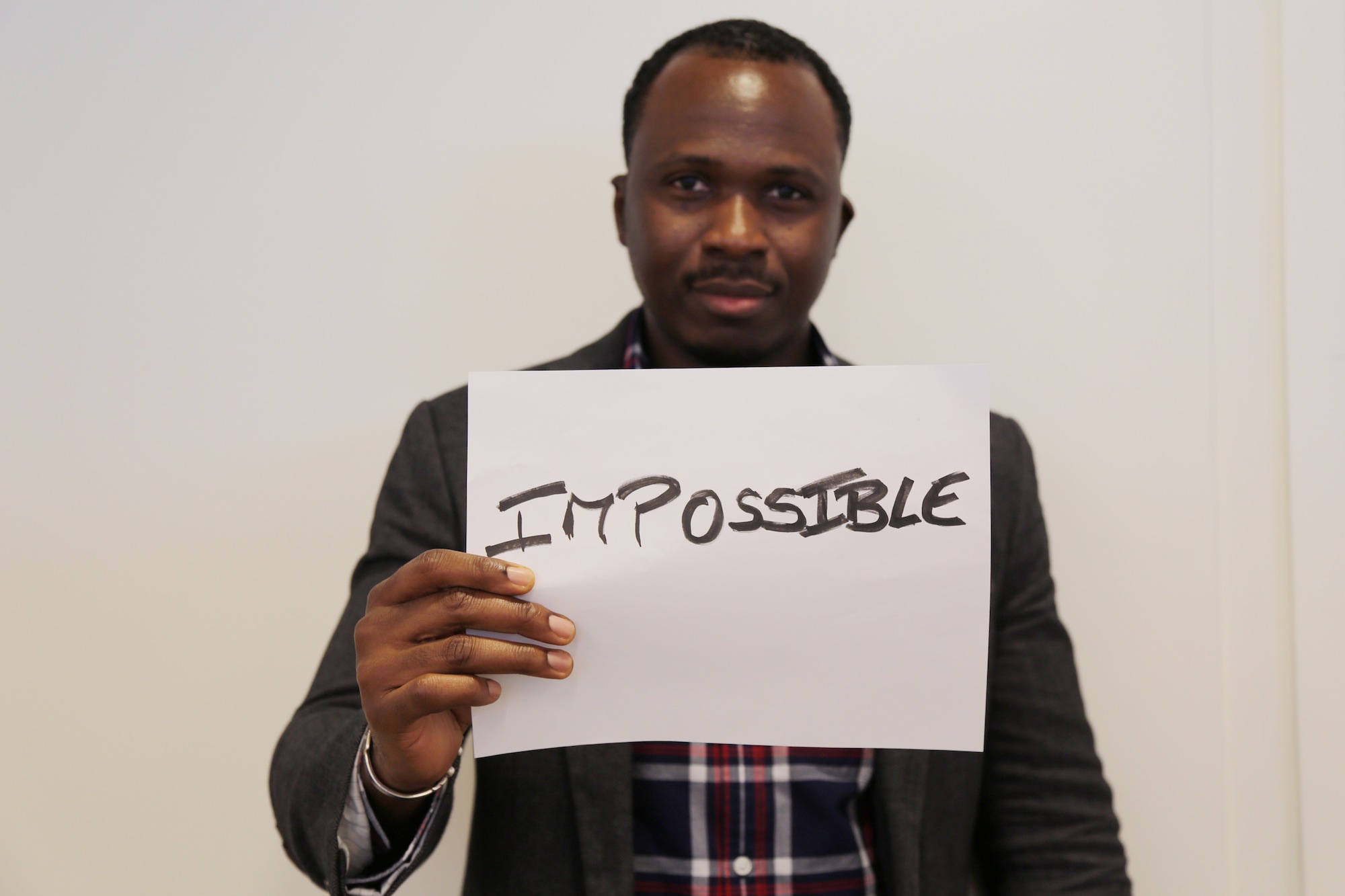
Serge's least favorite word: impossible

Impossible = well, impossible. Because, “Rien est impossible. C’est une histoire d’energie. Si tu penses que tu peux faire quelque chose, tu peux le faire, mais ça demande une certaine discipline, l’obligation, courage. Donc le mot ‘impossible,’ je ne l’utilise jamais.” [Nothing is impossible. It’s about your energy. If you think that you can do something, you can do it, but it takes some discipline, commitment, courage. So I never use the word ‘impossible.’] I asked Serge if there’s ever been anything he’s wanted to do but not been able to manage, and with a confident shake of his head he replied, “No.” (I wish I could say the same.)

Serge’s favorite word is the other side of the coin:

Serge's favorite word: foi

Foi = faith. Because: “Croire en soi, peu importe la situation, tout ira bien.” [If you believe in yourself, no matter what the situation, everything will be okay.] For Serge it’s a question of both religious faith and confidence in himself, though he added, “La confiance en moi vient de Lui.” [My self-confidence comes from God.]

So, it appears that Serge and I are polar opposites: he’s an optimistic man of faith, and I’m an agnostic ball of anxiety. But we are in agreement when it comes to our love of West African music. So I will take this opportunity to publicly remind Serge that he still owes me a mix tape. 🙂

the best of words, the worst of words: Philippines edition

Ruth in front of her village welcome sign

Two of the people I got to know on my Philippines trip were Ruth, with whom we filmed, and Juan, with whom we worked. They come from two different islands (Iloilo and Cebu) with two different dialects (Ilonggo and Cebuano). I thought it would be interesting to learn their favorite and least favorite words in their native tongues. And it was:

Ruth Celestial Cachuela is the captain (sort of like mayor) of her barangay (village), a community of 200-something households that sits on the northeastern shores of Iloilo. She has six children and six grandchildren, and she cares deeply about them and the wellbeing of her community. A very good person with whom to share a name! Her favorite word in Ilonggo: ruth's favorite word

Palanga means love, and Ruth chose it because, “I was loved by my parents, I was loved by my friends, I was loved by my husband, I was loved by the community, and even people who do not know me love me, because of what I have done. I also love them.” Her least favorite word:

Ruth's least favorite word

Baghak is an insult that means, according to Ruth, “You are downward, you don’t have knowledge for everything, like a monkey.” Ruth finds the word disrespectful and doesn’t like when people use it. She is a sower of love, not hate!

Juan Yao is a soft-spoken forester with an easy smile, born and raised in Cebu City. He is the kind of person whose presence makes you feel quiet and peaceful, which is why I was amused by his choice of favorite word:Juan's favorite word

Payter is the Filipino-ization of the English word “fighter,” and it is used as an exclamation when something is cool. I guess “baller” would be our closest approximation. As for his most hated word: Juan's least favorite word

Burikat is a crude word for “prostitute.” Juan doesn’t mind other words for prostitute, but this one he finds ugly.

So there you have it: Ruth and Juan, upstanding ambassadors of the Filipino lexicon. I now intend to integrate “fighter” into my everyday usage. As in, “I got to go to the Philippines. Fighter!”

the best of words, the worst of words: beauté and fourchette

the best word: beauteFollowing hot on the heels of Tuesday’s best and worst words, chosen for their signification, here are a best word and worst word chosen solely for their sounds.

Clovis is an artist with a studio in Bushwick who paints monochromatic extreme close ups of people’s faces. I wish I had one to post here but alas it didn’t occur to me to ask. Take my word for it, though, they are really wonderful.

His favorite word, beauté (beauty), seemed a bit of an obvious choice until he explained why. It’s not the meaning of the word that he likes but the sound. “Parce que le mot est rond.” (“Because the word is round.”) Which is to say, he loves the word beauté for the word’s beauty. Clovis insisted that even if beauté actually meant something terrible like decrepitude or diarrhea (my examples, not his), he’d still love it.

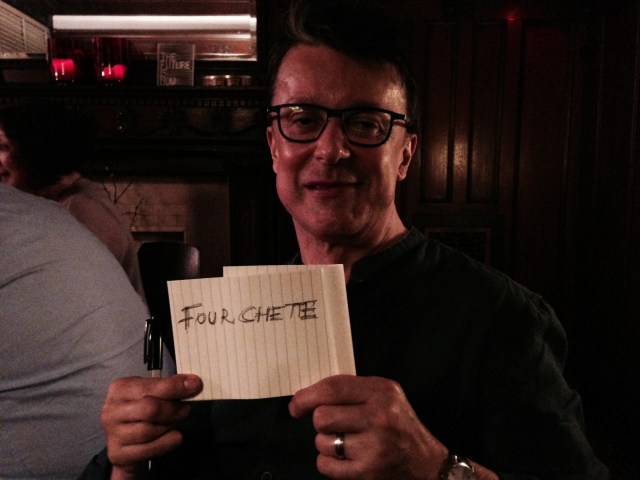
Clovis’ least favorite word seems hilariously random to me, especially when paired with beauté. But Clovis just does not like the sound of fourchette (fork). He said in French, “It’s not the meaning at all. A fork is very useful, but the word is like whiplash (un coup de fouet).”

I see what he means – the four takes its time rolling off the tongue and then the ette erupts out at the end. It’s jarring. the worst word: fourchetteBut I have to admit I like it – along with assiette (plate) and serviette (napkin). Why all the dinnerwear ending with ette?

In any case… Clovis – whose work is all about color – told me that he thinks of words in terms of color as well. Synesthesia, I love it! “Some are hot colors and some are cold colors, and some I prefer more than others.” Since Clovis said beauté was hot and fourchette was cold, I guess he likes a warm palette (another ette word I love).

Informal poll: fourchette, love it or hate it?

the best of words, the worst of words: lumière and obscurité

Thomas' favorite word: lumiere

This past weekend I had the pleasure of going to my former downstairs neighbor’s cocktail party in my old building, three blocks away from my new one. In addition to being fascinating and fabulous herself, Francesca has a set of fascinating and fabulous friends, two of whom are French. And thus, another edition of “best words, worst words” comes your way…

Thomas is a novelist whose work I am excited to dive into. He assured me that I would be able to read it in the original French. He is also about to shoot a documentary about Bushwick artists, including Clovis, who will be featured in the next installment of best words, worst words.

I was surprised at the ease with which Thomas chose his superlative words. No deliberation at all; they came right to him.

His favorite: lumière (light). Why? Because light signifies “knowledge, God, beauty. It’s the opposite of obscurity.”

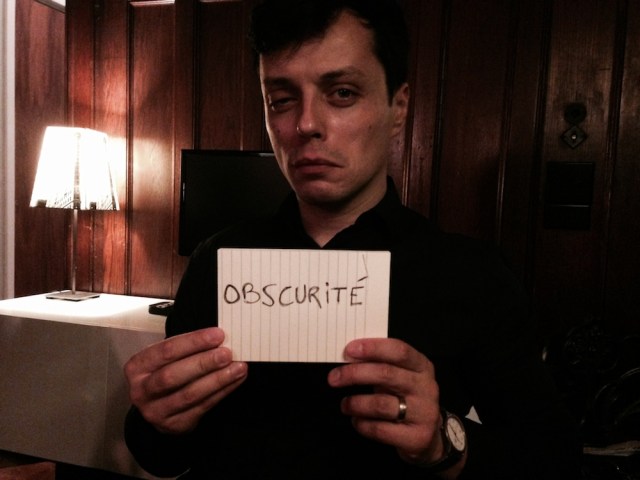
And his least favorite?Thomas' least favorite word: obscurite

Logically, obscurité (darkness, obscurity). Thomas believes that people cannot stand to live in obscurity – that they crave to be in the light, to be seen and known. Yet he also believes that people can’t live entirely in the light – that they need a small amount of obscurity to exist.

I don’t usually think of light and darkness as aspects of the human condition, but leave it to a writer to bring the poetry. Or leave it to the French language, I suppose. Until I noticed that obscurité translates to both darkness and obscurity, I hadn’t really linked the two. Darkness had always seemed physical and obscurity existential, but I suppose there is a lot of crossover – darkness can be existential and obscurity can be physical. I love these moments of lexical epiphany!

the best of words, the worst of words: dégueulasse & râler

Finally, the last of the three French party-goers:

degueulasse.jpg

Emmanuel is a sound recordist by day / artist by disposition. He has a bunch of strange and interesting side projects including a festival of boring films and a psychological danger meter. The intrigue of both were heightened by my inability to fully comprehend them in French – but I liked it that way so I didn’t ask for more details in English.

As is to be expected from a man with various hard-to-describe creative endeavors, Emmanuel’s picks for his best and worst words were similarly abstract and esoteric. He cycled through at least three worst words before settling on his absolute worst worst word. One of them was indifférence, which I found hilariously befitting of an artiste. His favorite word was also chosen with poetic logic. Dégueulasse: it’s not a nice word at all, but that’s part of the reason he likes it.

[Spoiler alert – if you don’t want to know how “Breathless” ends skip the next two paragraphs.]

Emmanuel explained (I think – it was not only that the French was slightly beyond my grasp but that the reasoning was, too): Dégueulasse is a crass word that you wouldn’t really say in polite company. In Godard’s first feature film, “À Bout de Souffle” / “Breathless,” the main character, a petty criminal played by Jean-Paul Belmondo, gets killed by the cops after being betrayed by his love, American ingenue Jean Seberg. As he lays dying he looks up at her and says, “C’est vraiment dégueulasse,” and it’s unclear what she’s feeling but it’s clear she’s feeling something very strongly. Then she asks one of the cops, “Qu’est-ce que c’est, dégueulasse?” but it comes out more like, “Qu’est-ce que c’est, deglasse?” It’s the first time she’s heard the word and she has no idea what it means. And then the movie ends. Honestly, I have always been perplexed by this. I know this last scene has deep meaning but I can’t put my finger on it, which makes me feel dumb and in turn, resentful of feeling dumb. I love “Breathless,” but man do I wish that the ending struck a chord with me in any way, shape or form.

Well, it struck a chord with Emmanuel. He thought that this ugly French almost-curse word, when it came out of Jean Seberg’s mouth in such an alien, foreign fashion, was given a new significance. The beauty of the word and the charm and possibilities of the language were revealed. Which I find amusing because to me the word sounds deeply hideous in that horrid American accent. Anyway…

Now for Emmanuel’s least favorite word. It’s not mignon, indifférence, or metastase, though those are three options he seriously considered before settling on:

raler.jpg

Râler – to whine or moan.

Why? Not entirely sure but it has something to do with the fact that while complaining (se plaindre) carries an agenda and implies that something gets done as a result, râler has no orderly purpose and, like its cousin geindre, is simply moaning sadly to make one’s objections known but to no apparent end. Emmanuel seems to think that the French love to râle about everything, good, bad or indifferent.

There might also be something about the r sound that Emmanuel finds grating but I’m not entirely sure. That part of the explanation was beyond my pay grade. 🙂

the best of words (glass half full / no worst of words edition): ananas

ananas.jpg

Finally getting around to writing up the other two best words/worst words from the party I went to last month. I’m getting the easier one out of the way first – easier first of all because Nico never told me his most detested word, only his favorite one; and also easier because he was a little tipsy and the only explanation he gave was to repeat the word’s various syllables, sounds and rhymes. To wit: “Parce que ananas, banana, bananas, des anana, anan, nana, nanas, des nana.” I asked him if, apart from the sound, he liked the taste of the fruit and he brushed me off, “Le goût, je m’en fou.” To be clear, Nico does enjoy pineapples, but he chose his favorite word for the sound rather than the deliciousness.

Interesting, because Félix’s favorite Spanish word was maracuyá (passion fruit) and my favorite word – in any language – is pamplemousse (grapefruit.) To state the obvious: I sense a fruit theme here…