exotic fruits of Senegal

A roundup of some of the delicious and new-to-me fruits I’ve sampled since being in Senegal:
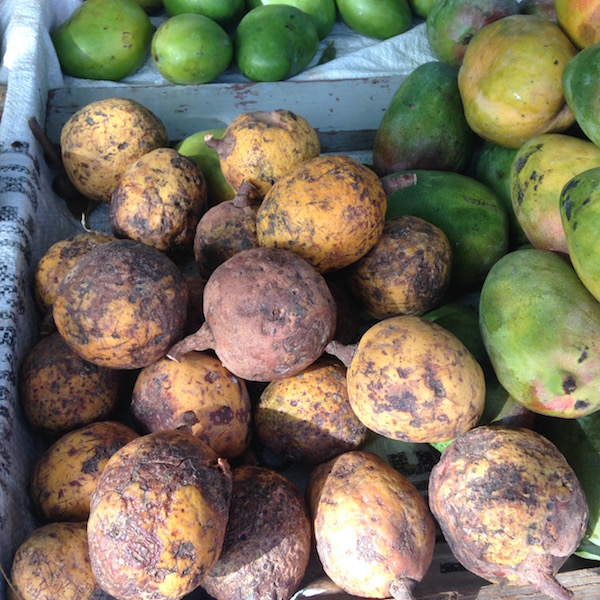
Madd is a seasonal fruit, available during the summer months, that seems to be most popular simmered with sugar and pepper down to a compote of small chunks of flesh in a sweet, sour, and spicy syrup.

You suck on the mouth-puckering pulp until you get to the stone-like seed.

I knew the baobab tree was important to Senegal symbolically but I didn’t realize it is also important nutritionally. Baobab fruit (also known here as bouye) is a superfood, packed with vitamins and nutrients.

When I tasted it fresh from the tree, it was powdery yet sticky, and like madd, both sweet and sour. I’ve also had it in biscuit, jelly, and juice/smoothie form.

I find the biscuit form rather weird, but the latter two are delicious – though sometimes far too sweet depending on how much sugar is added. It’s a strange paradox to me: Rather than gorge on all the French pastries available to them, the Senegalese usually opt for fruit as their go-to dessert. This would seem to indicate a rather weak sweet tooth… And yet they pour sugar into their juice. Perhaps this is like the middle way?
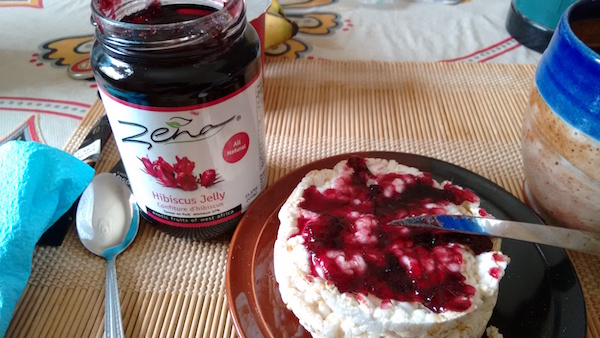
Bissap, known as hibiscus in English, is ubiquitous here. It’s made into jelly and into juice that tastes so much better than the hibiscus tea I’ve had in the States. To make the juice, the dried leaves are boiled and strained, and sugar – and sometimes fresh mint leaves – are added.
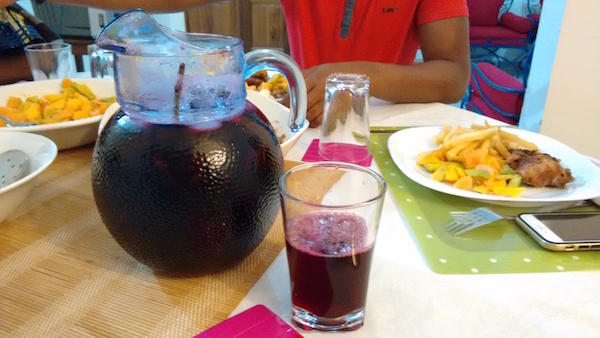
Also, since discovering orange blossom water a few months ago at a Lebanese cafe where they added it to my limeade and BLEW MY MIND, we’ve been putting it into bissap juice, which similarly takes it to next-level wonderful.
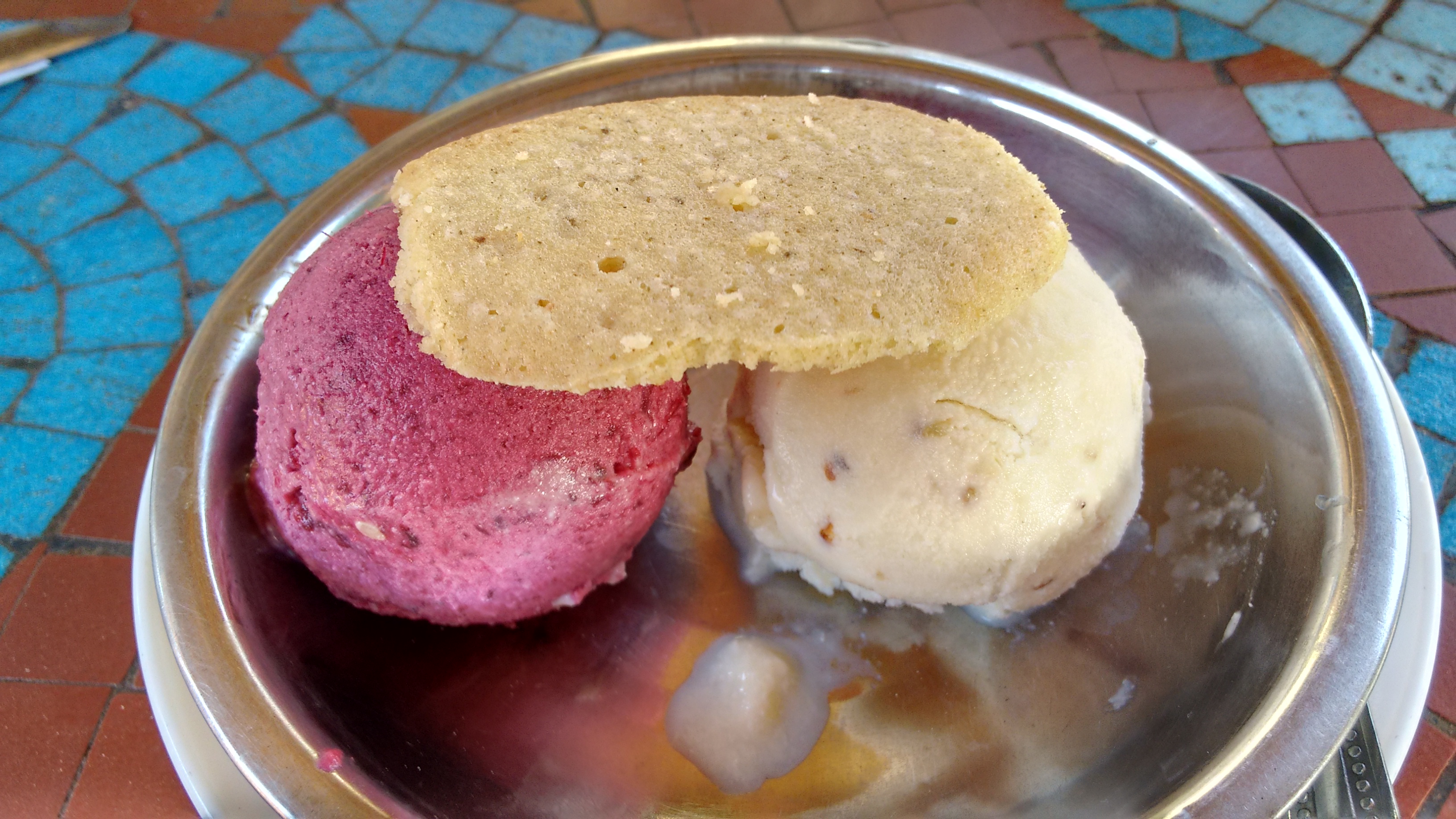
I’ve also had bissap in ice cream form. Above, a scoop of bissap and a scoop of ginger, both quite tasty.

Ditakh is a kiwi-like fruit that is made into fresh juice. I forgot to take a picture of the homemade version I tried, but here it is in bottled form. (Zena Exotic Fruits is a Lebanese-Senegalese business that turns all of these West-Africa-only fruits into delicious juices and jellies.)
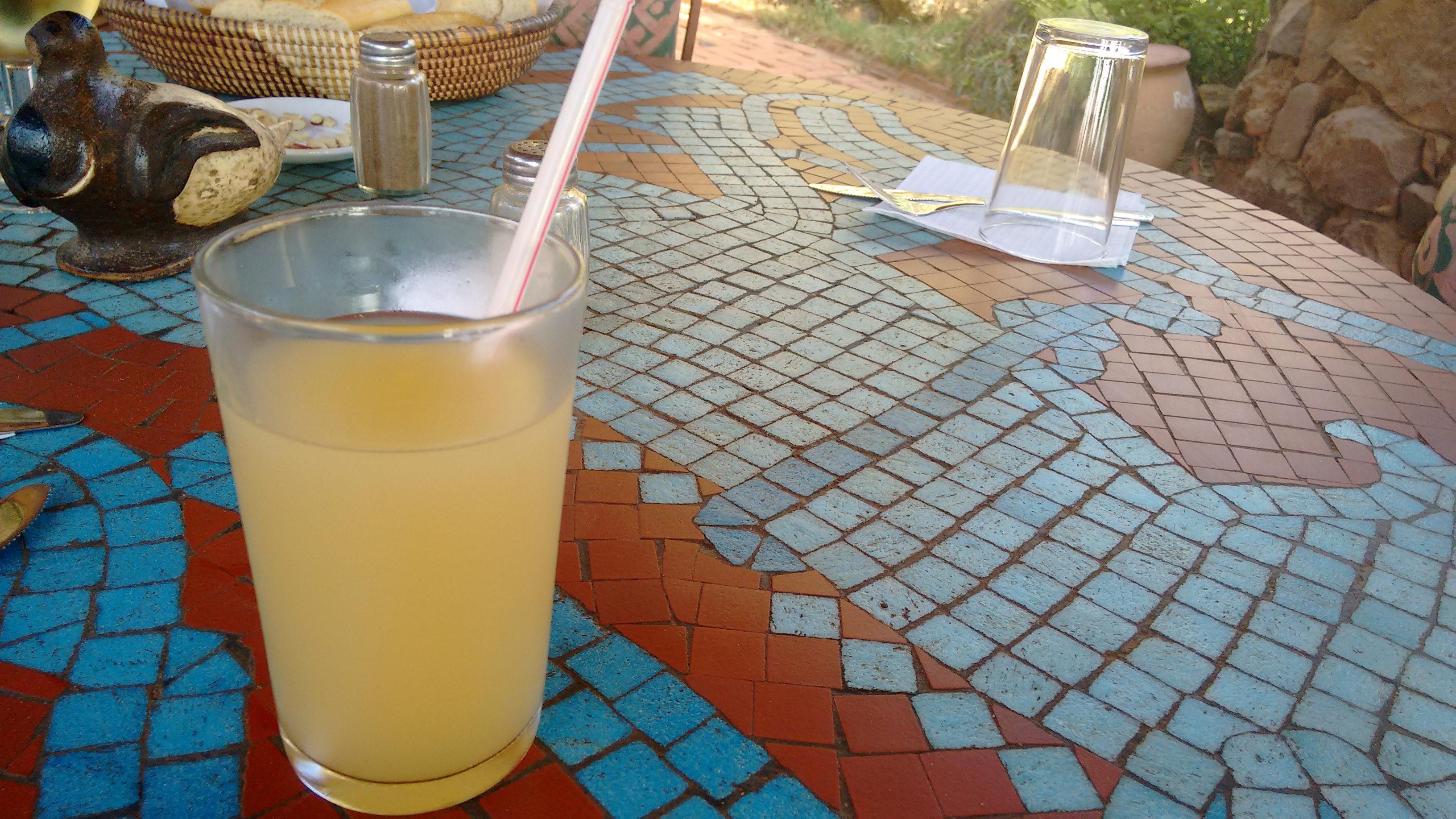
And my favorite local juice that I suppose is not actually from a fruit but whatever: jus de gingembre. Consisting of nothing but fresh ginger and water sometimes mixed with pineapple juice, it’s a potent and delightful drink that burns your throat all the way down.

This post has left me thirsty…

Oh, and I wrote before about the only fruit I’ve tried here that I found absolutely abhorrent: the sour unripe mango.

Sweet and sour seems to be a thing here, but in this case the sour goes way, way too far.
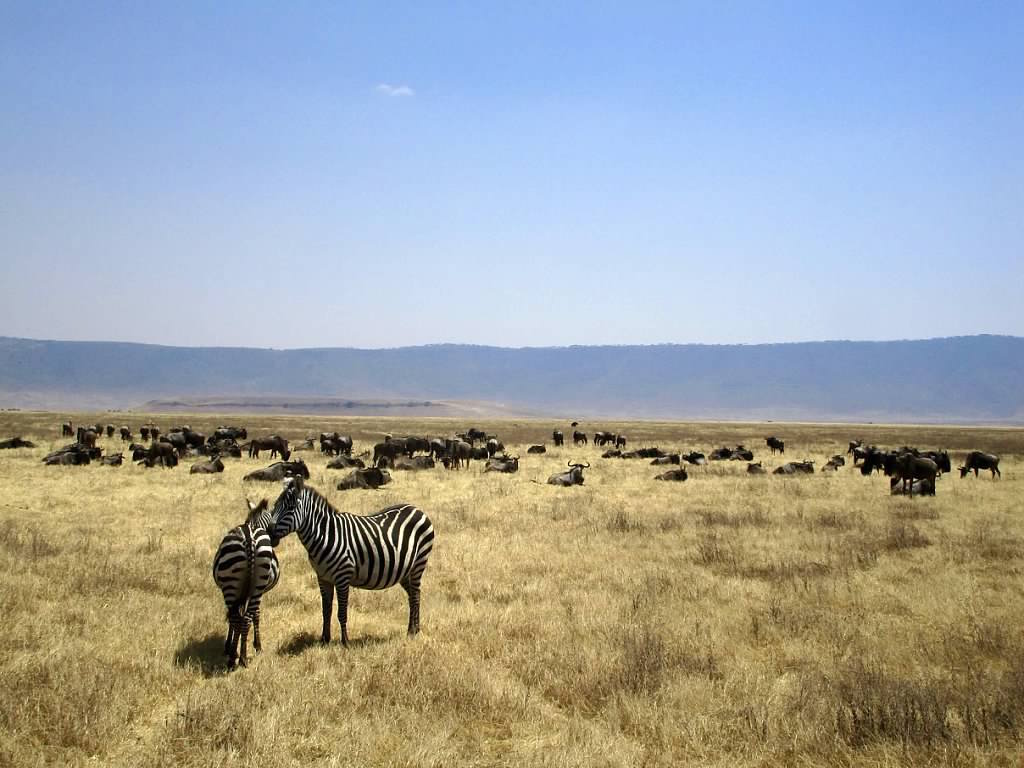
Tanzania part one: the safari

On the tail end of my Ethiopia trip in August, I met my two decades-long friend, Randy, to begin a Tanzanian safari-Zanzibar adventure. We met up in the Addis airport. She was coming from DC, and we flew together to Kilimanjaro Airport, where we were picked up by our safari company. It was too cloudy to see Mount Kilimanjaro on the hour-long drive to Arusha, which was disappointing for reasons best left not explicitly stated for fear of being Toto-shamed. Continue reading

Dakar signage

A small sampling of signs I have been amused by lately:

It took me six months to notice the one above, across the street from my house, but now I can’t stop seeing “beware of horse-drawn cart” signs everywhere. Which makes sense, since horse-drawn carts are ubiquitous in Dakar, including on all the main roads. As well as in front of my house:

Not only do I love seeing the horses and whatever they’re carrying, but I also love hearing their peaceful hoof sounds. It’s like a little bit of the country in the city.

When I saw Orange (a French telecom company)’s sign, which says, “Recharge and win 1 sheep per day,” I thought perhaps “mouton” (sheep) in French was similar to “buck” (a kind of deer) in American English – i.e. a dollar (or in this case a CFA). But I wasn’t sure, because everyone seems to own a sheep or two around here and I had never heard of “mouton” being used as slang before. Then Tabaski aka Eid al-Adha came and went and the mystery was solved. Muslims slaughter sheep for the holiday meal and it had been a pre-Tabaski sheep giveaway… tied to recharging your cell phone. If that isn’t old world meets new world I don’t know what is.

This one just cracks me up. It translates literally to, “You do not have priority.” I suppose it is a “yield” sign, although before this I had only ever seen ones that firmly but politely say, “Cédez le passage.” This one had so much extra attitude that I found myself personifying it sort of like this:

And with that, enjoy your weekends and rest assured that you DO have priority, so go out and do something nice for yourself.

a mental cleanse…

Yesterday I bucket bathed for the first time in Senegal. I came home from a 3-mile run in 80 degree weather, to find there was no water in the house. As has happened very occasionally since I’ve lived here, a power cut in another part of town affected the delivery of water to our neighborhood.

In my drenched-in-sweat state, there was no question of skipping a shower and waiting, perhaps until morning, for the water to come back on. So, Mamie procured a bucket of water for me from somewhere, and I proceeded to (attempt to) bathe.

There’s nothing like epically failing at the elementary task of washing yourself with a bucket of water, to bring home your privilege to you. The only other times I’ve done it were on camping trips and during shoots in very rural areas of Liberia and the Philippines. In those in-the-field settings, a crappily executed rinse seemed par for the course. But standing in my own well-appointed, middle class, temporarily non-functioning shower in Dakar, and realizing that I was coating myself in a film of soap rather than actually cleaning myself with it, felt different. I was struck by the accident of birth that had granted me a life of never having to work very hard to clean myself, while others had never in their lives stood for 20 minutes underneath a shower head enjoying the running water.

I suppose the rhetoric of this election was also ringing in my (sudsy) ears as I noted my profound bucket-bathing ineptitude. Had I watched the second presidential debate in New York, I would have been offended by the assertion therein that “we’ve become a third-world country.” But having watched via painfully slow Internet in Dakar, with memories of people I filmed in Senegal, Benin and Liberia fresh in my mind – people who live in families of six to twelve people, in two-room homes without electricity or running water, on less than $1 a day – I was physically sickened by the level of insulation and indifference you’d have to ensconce yourself in to permit those words out of your mouth – or to condone them.

Every time there’s a power cut here, which happens as rarely as once a month or as frequently as multiple times a week and can last anywhere from a few minutes to eight or nine hours, someone in my household will shrug their shoulders at me and say, “C’est Senegal.” While we live in relative ease most of the time, all the money in the world can’t buy reliability that doesn’t exist without the necessary infrastructure.

In my work and travels this year, it’s not just undependable or absent utilities that I’ve seen up close and personal – it’s also unreliable democracy and ineffectual government. The confluence of my time abroad with this election has, at least, done wonders for my sense of gratitude and responsibility. It has made me more viscerally cognizant of how lucky I am as an American to have access to both modern infrastructure and a solid democracy. And it has reinforced my belief that I am only as entitled to these gifts as every other human being is.

I don’t mean to moralize or preach here, except perhaps to myself. I’m more trying to reflect on how a disgusting election and an unpleasant bucket bath have contributed to my personal growth. (And also probably my bacterial growth.)

And with that, I’m going to go take a very thankful shower, now that the water is back.

the weekend is here

Yesterday was an unexpected day off but today was a quite intentional one. I finally made it back to IFAN to check out the permanent exhibit, which consists mostly of amazing masks from initiation ceremonies across West Africa.

After that I came back to my neighborhood for a late afternoon aquabike session. It was a very nice culture-sport 1-2 punch.

And now after two days of faux weekend it’s the real weekend. There’s an afropop dance night uptown in Almadies tonight, and I think I may search out brunch for the first time ever in Dakar tomorrow… We shall see.

Have a lovely weekend and if the spirit moves you, check out the reads that I have enjoyed this week:

A fellow later-in-life language learner reflects on our cultural preoccupation with a fluency finish line.

Continuing the Yiddish theme from last week, this week I read, “My Mother’s Yiddish,” a one year old but timeless essay.

Get up to speed on greetings around the world, including Tibet’s very unusual custom.

Bucket list places that are going to disappear to climate change. 😦

Californians may expand the bilingual education they once curbed.

I found the reader responses to “Advice for Solo Female Travelers” much more true and useful than the original article.

Only three people know how to make the rarest pasta on earth…

And I think I forgot to include this one in an older post, but better late than never:

The most inaccessible places in the world that people desperately want to visit.

Six distinctive things about Ethiopia

A few things that stood out to me:

– Their scaffolding is seriously death-defying (or not). Ethiopia was the first time I saw anything like this and I thought it was a unique quirk of the country, but then I saw it in Benin and said a silent prayer for their construction workers, too.

– Juice bars are ubiquitous, and mixed juice smoothies served parfait-style is very popular (and delicious, especially when avocado is one of the layers).

I would think that having juice bars on every corner would be the bi-product of a country in which alcohol is prohibited, but that’s not the case. Maybe they just know that they lucked out in the local fruit lottery (papaya, mango, avocado, pineapple…) and are taking advantage of it?

– As I mentioned before, Ethiopia is the only African country not to have been colonized by the West.

– Ethiopian cuisine is entirely unique.

The ancient grain, teff, is grown throughout Ethiopia and hardly anywhere else in the world. Since teff is what injera is made out of, and since injera is served with almost everything, it means that Ethiopian food tastes different than any other food on earth (except for maybe Eritrean?…).

Here’s a recent New York Times article about how Ethiopia is negotiating the tricky balance of bringing teff to the world market without rendering it out of reach of Ethiopians. (As was the case with quinoa in South America.)

– I have never seen anything like Ethiopian shoulder dancing, aka eskista:

I can’t say it (literally) moves me, but it does fascinate me.

– They use their own quirky clock (and their own calendar), and it definitely doesn’t match their official time zone. This article explains.

breakfast of Senegalese champions

This millet porridge is called lakh and it’s the traditional breakfast across Senegal. It’s really heavy and in olden days was perfect for keeping farmers full all morning in the fields. If you’re a working stiff with a desk job, though, it’s a bit of a soporific, so these days in Dakar a baguette with Nutella or Chocopain (the Senegalese equivalent, made with peanuts instead of hazelnuts) is a more typical morning meal.

Traditionally, lakh is eaten with sweetened lait caillé – fermented milk, sort of like a very pungent yogurt. But here the Lo ladies are just eating regular store-bought yogurt and some condensed milk on top.

It is delicious and filling and a gluten-free alternative to the rice cakes I’ve been eating every morning and which got really old really fast (even smeared with exotic bissap/hibiscus or baobab jelly).

I wonder why millet isn’t more popular in the States. I feel like it’s only a matter of time before people start saying that millet is the new quinoa. Although amaranth might get there first…

a French first

on a boat.jpg

Back from Benin! Four days of my week there – Tuesday through Friday – were spent on a boat, during which time I experienced no sea-sickness… until I was on solid land. Just a few minutes after I stepped into my hotel room on Thursday evening, I started feeling the odd sensation that I was still out on the water. My head was swimming back and forth and I couldn’t get my balance. I’d be fine one minute, and gripped by wooziness the next. I figured it was dehydration, so I drank a lot of water, went to bed, and felt fine the next day.

But then last night, after the longest day on the boat yet, the swaying got worse. I almost fell over in the shower. My head started lolling back and forth of its own accord. I met a French friend of a friend for dinner and when I told him how weird I felt he nodded knowingly and pronounced, “Ah, oui, mal de terre.” Apparently, mal de terre is the flip-side of mal de mer, but with the same general sense of malaise. It happens after you spend a lot of time at sea and then return to earth. I guess my brain is confused about whether it is still out there on the waves or not. More than 24 hours after I got off the boat for the last time, and all the way back in Dakar, I am still swaying from side to side and feeling not exactly nauseous, but nevertheless pretty icky.

Anyway, the silver lining here is that I do not know any actual English word or phrase for “land-sickness,” so mal de terre is the very first French that I have ever learned before its English equivalent. I find great pleasure in that, despite the condition itself being not at all pleasurable. (I also enjoy the fact that mal de mer and mal de terre are so personifiable – I’m imagining them as Oompa Loompa-like twins whose rhyming names make them seem charming but who are actually malicious little imps.)

More once my head stops spinning…


beautiful buildings of Dakar

I am a big fan of midcentury design in general and a huge fan of midcentury African architecture in particular. There seems to be a huge range of styles, each drawing from different regions, periods, and influences. I’ve been calling it all Midcentury African for now and promising myself to look for actual terminology and history later, whenever I find the time to go down that rabbit hole.

For months I’ve been taking pictures of my favorite of these buildings in Dakar and it’s high time I shared them… Continue reading

Ethiopia

img_20160806_140832464

Last month I went on a whirlwind three-country tour of Ethiopia, Tanzania, and South Africa. Carrie Bradshaw once told Big, “We’re so over, we need a new word for over.” On this vacation I repeatedly told myself, “This is so amazing, I need a new word for amazing.”

This post is devoted to my Ethiopian amazement… Continue reading