exotic fruits of Senegal

A roundup of some of the delicious and new-to-me fruits I’ve sampled since being in Senegal:
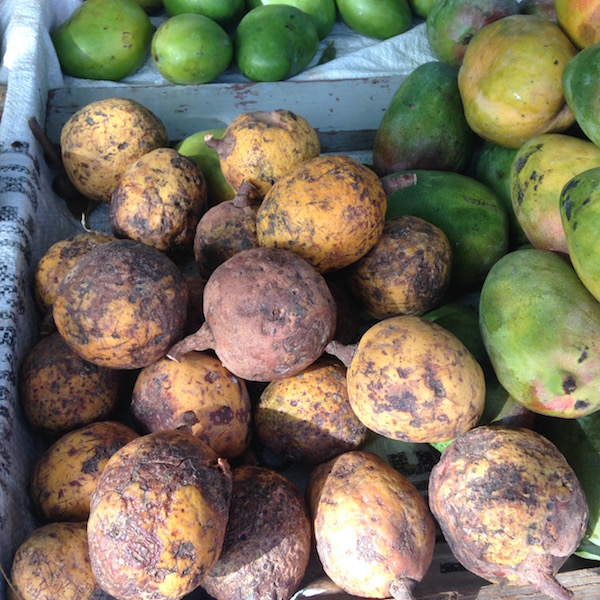
Madd is a seasonal fruit, available during the summer months, that seems to be most popular simmered with sugar and pepper down to a compote of small chunks of flesh in a sweet, sour, and spicy syrup.

You suck on the mouth-puckering pulp until you get to the stone-like seed.

I knew the baobab tree was important to Senegal symbolically but I didn’t realize it is also important nutritionally. Baobab fruit (also known here as bouye) is a superfood, packed with vitamins and nutrients.

When I tasted it fresh from the tree, it was powdery yet sticky, and like madd, both sweet and sour. I’ve also had it in biscuit, jelly, and juice/smoothie form.

I find the biscuit form rather weird, but the latter two are delicious – though sometimes far too sweet depending on how much sugar is added. It’s a strange paradox to me: Rather than gorge on all the French pastries available to them, the Senegalese usually opt for fruit as their go-to dessert. This would seem to indicate a rather weak sweet tooth… And yet they pour sugar into their juice. Perhaps this is like the middle way?
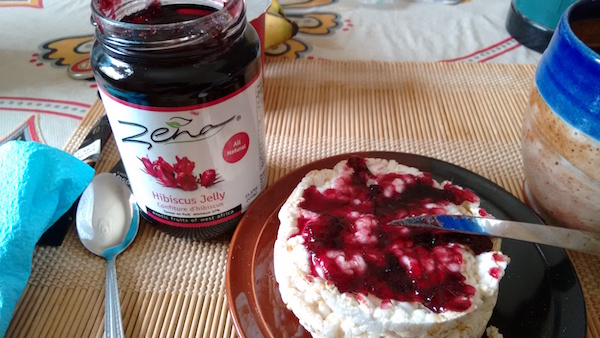
Bissap, known as hibiscus in English, is ubiquitous here. It’s made into jelly and into juice that tastes so much better than the hibiscus tea I’ve had in the States. To make the juice, the dried leaves are boiled and strained, and sugar – and sometimes fresh mint leaves – are added.
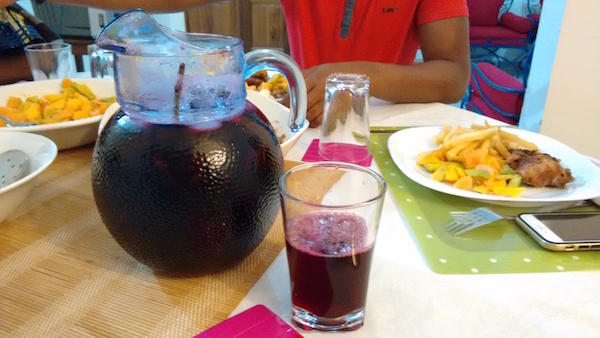
Also, since discovering orange blossom water a few months ago at a Lebanese cafe where they added it to my limeade and BLEW MY MIND, we’ve been putting it into bissap juice, which similarly takes it to next-level wonderful.
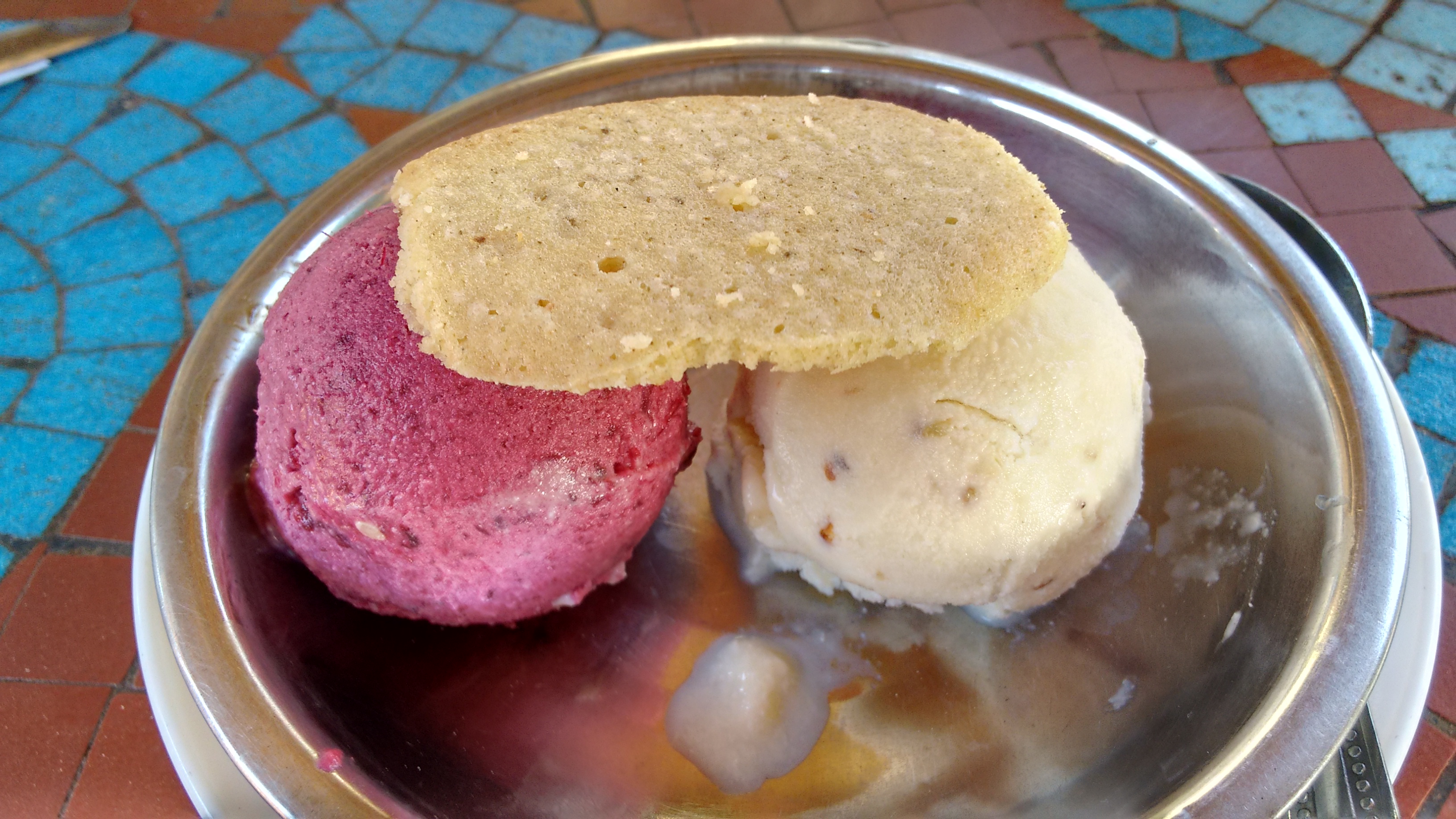
I’ve also had bissap in ice cream form. Above, a scoop of bissap and a scoop of ginger, both quite tasty.

Ditakh is a kiwi-like fruit that is made into fresh juice. I forgot to take a picture of the homemade version I tried, but here it is in bottled form. (Zena Exotic Fruits is a Lebanese-Senegalese business that turns all of these West-Africa-only fruits into delicious juices and jellies.)
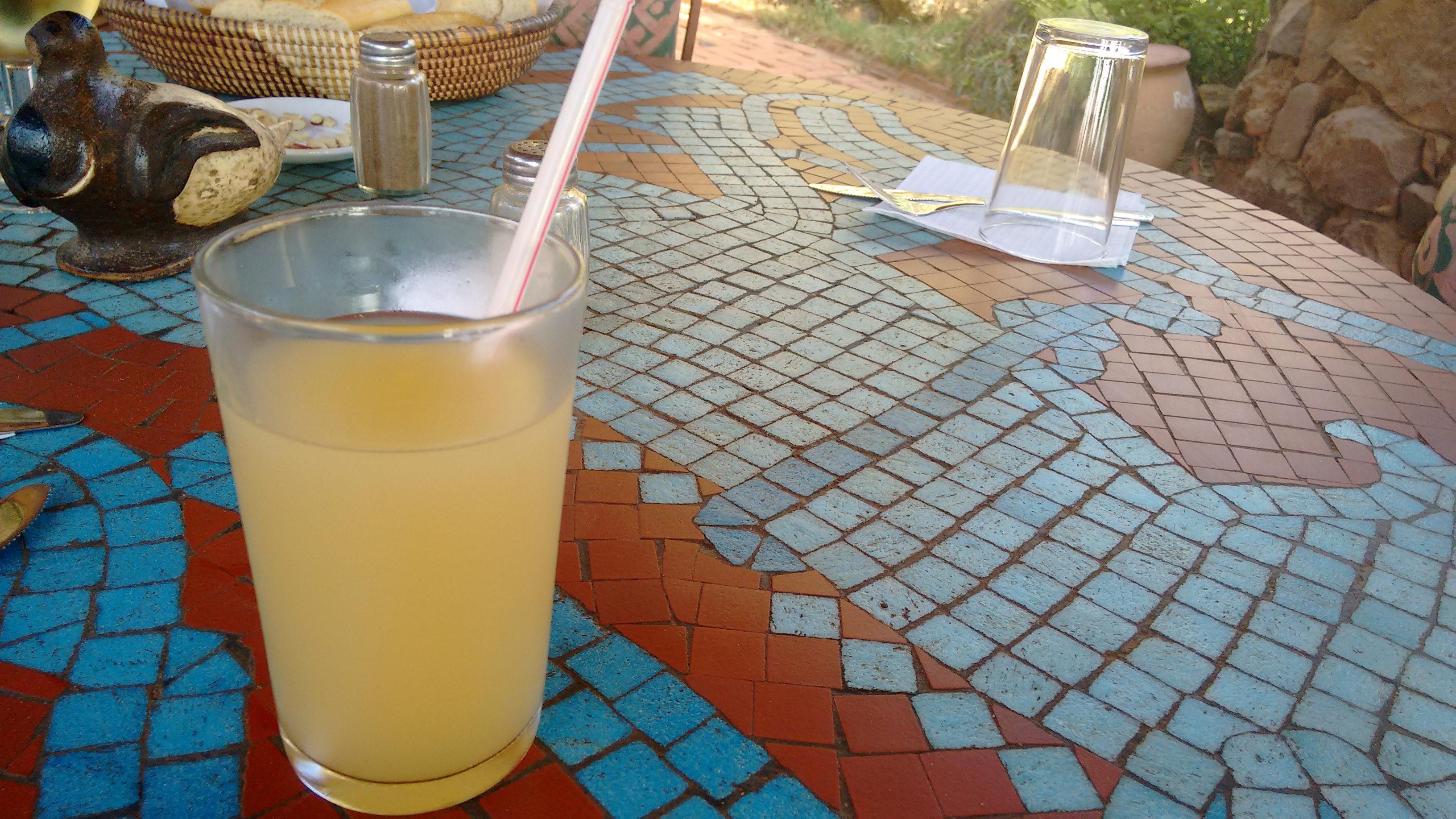
And my favorite local juice that I suppose is not actually from a fruit but whatever: jus de gingembre. Consisting of nothing but fresh ginger and water sometimes mixed with pineapple juice, it’s a potent and delightful drink that burns your throat all the way down.

This post has left me thirsty…

Oh, and I wrote before about the only fruit I’ve tried here that I found absolutely abhorrent: the sour unripe mango.

Sweet and sour seems to be a thing here, but in this case the sour goes way, way too far.
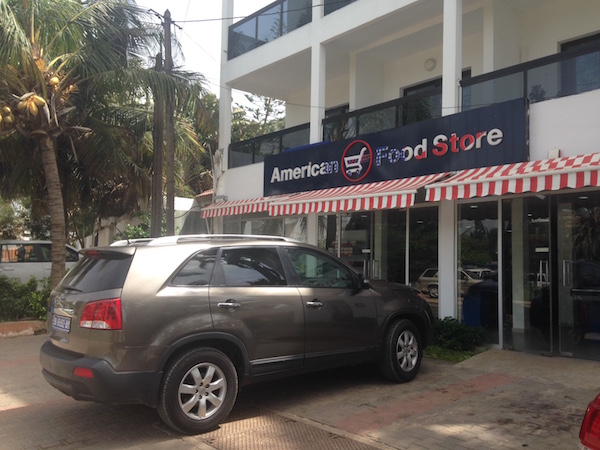
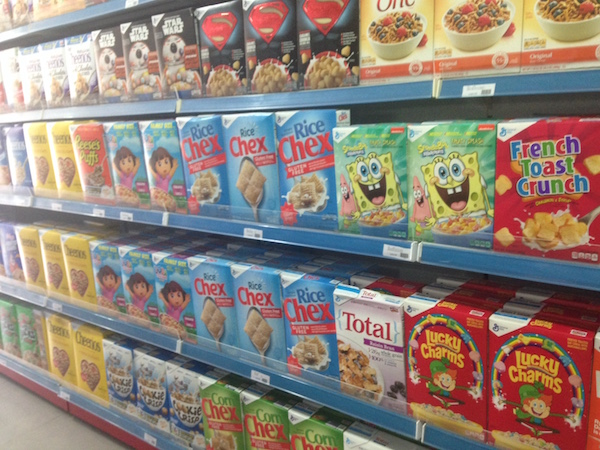
The American Food Store

After eight months of living without many of my most familiar, beloved and/or regularly eaten foods, I finally visited the American Food Store in Almadies. I had been holding out as a point of pride, but also because I was never in the immediate vicinity and didn’t expect to find much there that I’d really want. There’s no way to not sound like a snob saying this, but most American food exports are not the kind of thing I ate in the United States anyway, whether because of dietary restrictions, nutritional preferences, or personal taste.

Anyway, a couple of weeks ago on my way to drop off my absentee ballot at the American Embassy, I passed the American Food Store and felt it was time to stop in and see what they had to offer.

Surprisingly, the answer was: the entire range of human emotion. Browsing through the aisles of the American Food Store, I swung widely from one strong feeling to another. There was the joy of cultural recognition when I saw the jumbo-sized canisters of Heinz ketchup, yellow mustard and relish. There was amusement when I spotted the section devoted to beef jerky. There was deep (misplaced) nostalgia at the Jiffy-Pop stove-top popcorn. It was misplaced since when I was a kid we used to make popcorn with a machine, but something about the Americana of it got to me. There was deep (real this time) nostalgia in the candy aisle, with its Mounds and Mars and Three Musketeers and Baby Ruths.

There was delight when I spotted Reese’s Peanut Butter Cups among the chocolate offerings. (Ten minutes later, there was disappointment when I realized that my palate has changed after months abroad, and Reese’s Peanut Butter Cups now taste more like sucking on a packet of sugar than eating deliciously sweetened peanut butter.)

There was relief when I saw that they sell cans of cranberry sauce, which means that I can attempt to recreate Thanksgiving here in Dakar. There was detachment when I spied Starbucks coffee, a newly stocked item, next to the Café Bustelo and resigned myself to sharing this city with the empire I hate most. There was gratitude when I found gluten-free pasta, and anger when I noted the 300% markup of gluten-free pasta (and everything else).

But mostly there was revulsion. Not to make a mountain out of a molehill… but the United States has really lost its way when it comes to sustenance of both the body (and, I would add, the soul). I already knew that while I was living there, but “dropping in” from somewhere else makes it stand out in sharp relief.

img 7131

img 7132

img 7133

Six distinctive things about Ethiopia

A few things that stood out to me:

– Their scaffolding is seriously death-defying (or not). Ethiopia was the first time I saw anything like this and I thought it was a unique quirk of the country, but then I saw it in Benin and said a silent prayer for their construction workers, too.

– Juice bars are ubiquitous, and mixed juice smoothies served parfait-style is very popular (and delicious, especially when avocado is one of the layers).

I would think that having juice bars on every corner would be the bi-product of a country in which alcohol is prohibited, but that’s not the case. Maybe they just know that they lucked out in the local fruit lottery (papaya, mango, avocado, pineapple…) and are taking advantage of it?

– As I mentioned before, Ethiopia is the only African country not to have been colonized by the West.

– Ethiopian cuisine is entirely unique.

The ancient grain, teff, is grown throughout Ethiopia and hardly anywhere else in the world. Since teff is what injera is made out of, and since injera is served with almost everything, it means that Ethiopian food tastes different than any other food on earth (except for maybe Eritrean?…).

Here’s a recent New York Times article about how Ethiopia is negotiating the tricky balance of bringing teff to the world market without rendering it out of reach of Ethiopians. (As was the case with quinoa in South America.)

– I have never seen anything like Ethiopian shoulder dancing, aka eskista:

I can’t say it (literally) moves me, but it does fascinate me.

– They use their own quirky clock (and their own calendar), and it definitely doesn’t match their official time zone. This article explains.

breakfast of Senegalese champions

This millet porridge is called lakh and it’s the traditional breakfast across Senegal. It’s really heavy and in olden days was perfect for keeping farmers full all morning in the fields. If you’re a working stiff with a desk job, though, it’s a bit of a soporific, so these days in Dakar a baguette with Nutella or Chocopain (the Senegalese equivalent, made with peanuts instead of hazelnuts) is a more typical morning meal.

Traditionally, lakh is eaten with sweetened lait caillé – fermented milk, sort of like a very pungent yogurt. But here the Lo ladies are just eating regular store-bought yogurt and some condensed milk on top.

It is delicious and filling and a gluten-free alternative to the rice cakes I’ve been eating every morning and which got really old really fast (even smeared with exotic bissap/hibiscus or baobab jelly).

I wonder why millet isn’t more popular in the States. I feel like it’s only a matter of time before people start saying that millet is the new quinoa. Although amaranth might get there first…

Ethiopia

img_20160806_140832464

Last month I went on a whirlwind three-country tour of Ethiopia, Tanzania, and South Africa. Carrie Bradshaw once told Big, “We’re so over, we need a new word for over.” On this vacation I repeatedly told myself, “This is so amazing, I need a new word for amazing.”

This post is devoted to my Ethiopian amazement… Continue reading

on teranga

gateau.JPGAll week, I have been almost-crying with frustration as I attempt to upload videos for my client in New York. My average network speed ranges from 1MB per minute to 1MB per seven minutes. Not joking. Really, really not joking. My host brother has a different service provider that goes at about 2MB per minute, which is much better, except that the uploads frequently crash. Even when uneventful, it still takes hours upon hours to get a file of less than 1GB into the digital ether. (Faster connections exist, but I can’t access them because of the neighborhood I live in. And I can’t borrow them either, because all my people with better connections are away on vacation this week.)

The ongoing upload debacle has slowed everything else down during a week when I’m frantically trying to get things done before I leave on vacation tomorrow morning. One of my errands was to print all my itineraries and reservations. There’s a shop near Cor Coumba cafe where you can hop on their computer and do printouts. I rushed in there a few hours ago ready to get to business and cross one of eight million things off my to-do list.

When I stepped behind the counter (because you’re borrowing the store’s computer as opposed to using one reserved for the public), I saw that the three employees were sitting around a shared bowl of thieboudienne. They immediately told me, “Viens manger.” I thought I might have misheard, because why would strangers invite a random person to join them in their meal – especially a meal made more intimate by everyone eating with their hand from one bowl.

I demurred. They said it again. My mood shifted from frazzled to touched. (But I still demurred, because I had just eaten and because even though it may or may not have been polite to turn them down, I just really was not in the mood for fish.)

I did my printing. On my way out they offered me attayah. Again, I was really touched, but again I declined as politely as possible. I actually don’t know why I said no this time, because I really like attayah. I think I was just in must-get-shit-done mode.

But on the walk home, I thought about how Senegalese teranga – hospitality – makes up for all the times I’ve wanted to punch a wall because the Internet is simply not moving an inch.

Back at the house, I smelled something delicious wafting from the kitchen, and Tantie told me, “I made you a cake.” She loves baking but I’ve never been able to eat any of her confections because there’s always wheat flour in them. This time she used my gluten-free saracen (buckwheat), which after lots of searching I had recently found at a supermarket geared towards ex-pats.

I am not sure if the cake was because I am about to leave town for a month or just a well-timed coincidence, but either way I thought it was a really sweet gesture.

I cannot wait to be done with my uploads and on vacation in a new-to-me part of the world tomorrow, but I’m really going to miss my adopted family and my adopted neighborhood and Senegal in general. Somehow the planet-sized ball of molten Internet hate eating away at me this week has been sublimated, by their heart and by the otherwise-amazingness of living here.

P.S. There’s no way I’m going to get around to writing anything else here before I leave (and probably not while I’m away, either), so have a lovely August and see you in a month!

coffee chronicles

An update on my quest to find freshly brewed coffee in Dakar:

A while ago, Tantie (Mamie’s younger sister; real name Armand) recommended I try Presse Cafe, in the neighborhood of Plateau. After three caffeination-starved months in Dakar, the sight of their bean grinders and espresso machines felt like spotting a unicorn.

I now stop in to the cafe every time I’m downtown, but it’s too far to go for my daily fix. Fortunately, I recently discovered an even better place right in my own backyard.

A ten-minute walk from my house, through the dusty pastel streets of Amitié, an inconspicuous shop called Coumba Cafe does their own roasting and grinding and brews an uber-strong cup of espresso topped with a perfect layer of crema (a word I learned only during my recent coffee obsession).

The first time I drank one tiny shot of it, I had to down a liter of water and eat a banana to calm the coffee shakes. Tremors aside, it was heavenly to be so wide awake.

Now I’m a regular there. I love their decidedly non-cafe-like decor and that they’ve been around since the 80s.

For less than a dollar, I get my espresso fix from someone who knows my order without me saying a word. Apparently they make a delicious version of cafe touba that, unlike the kind sold on the street, actually wakes you up, but so far I have stuck to the espresso because I don’t really believe in a world in which cafe touba possesses powers of caffeination. Maybe one Saturday when I don’t have any work to do I’ll try it out.

On that note, I’m heading there now because my brain is still not fully functional and it’s after 12pm!

Portugal eu te amo

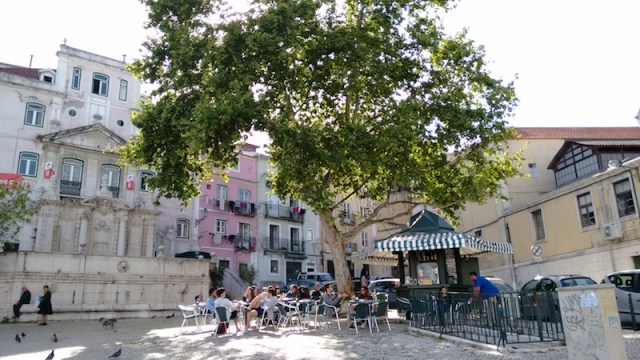
abeautifulsquare

Hard to believe it’s been almost two months since I left Dakar for a vacation starting in Lisbon. Life has been moving along from one thing to the next pretty quickly, and I am only now coming up for air after a whirlwind tour of Portugal, Morocco, Liberia… and Adobe Premiere, whose depths I plumbed day in and day out for the past three weeks while working on various video deadlines.

Since those deadlines are not yet completely behind me, I’m still liable to go MIA for days at a time, but I now have a ton of stuff to post here, so I’ll try to keep up with it.

On that note, here are some many photos from Portugal. Continue reading

Joyeuses Pâques

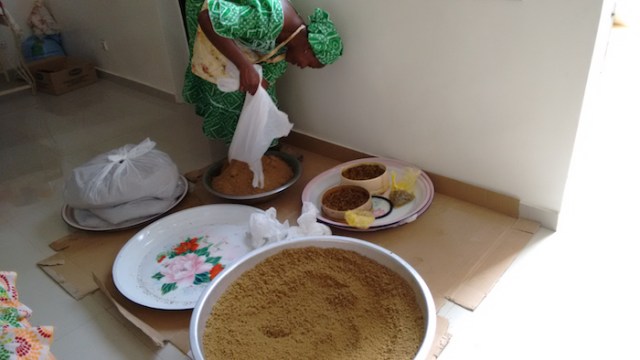
millet_and_raisins_and_nutmeg.jpgWhile 95% of Senegalese are Muslim, my host family is Catholic. For Easter, they went all out making a traditional treat called ngalax.

On Friday morning I came downstairs to find this woman sifting vats of baobab fruit into a fine powder. baobab_for_ngalaxOn Friday night I was pressed into service opening packet after packet of vanilla sugar and dumping it into a bucket. (Why they do not sell non-packeted vanilla sugar, I could not get an explanation.)

On Saturday morning the kitchen and courtyard downstairs were overflowing with women I had never seen before, all playing their special parts in the assembly line of ngalax mass-production.

Here are some of the ingredients waiting to be incorporated: millet, raisins and nutmeg (which was freshly grated along with orange rind).millet_and_raisinsThey lightly toasted the millet. miles_of_milletAnd then they added it to these vats of baobab powder mixed with the Senegalese version of peanut butter and the other fixings. (That’s my host mom below.)baobab_fruit_bitesThe resulting concoction looked highly unappetizing but tasted highly delicious. (Although I have no idea how my host sister’s boyfriend ate four bowlfuls in a row – after one both my stomach and mind were in a stupor.) ngalaxThey made 60 buckets of this stuff (!!!) and, as is the tradition, gave it out all over town in visits to family, friends, and neighbors throughout the day and into the night.
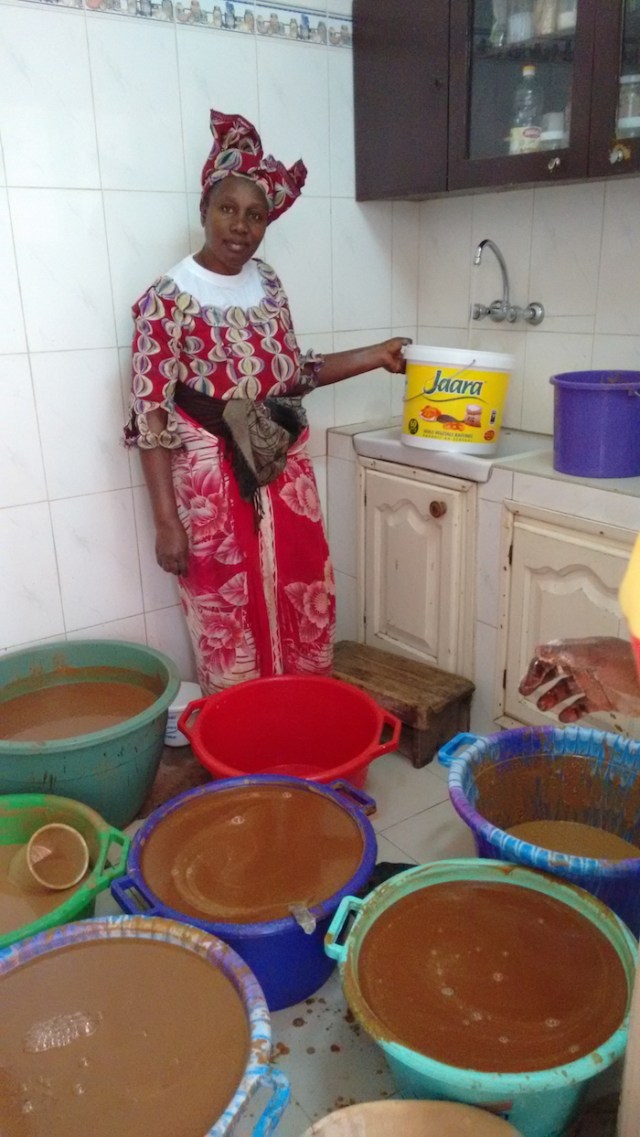
vat_of_ngalax.jpgThen they all went to midnight mass, which I was originally interested in checking out until I heard that Orchestra Baobab was playing a show at Just4U. Priorities!

Kaolack et Latmingué redux

baobab_fruit

Two-day filming trip, back to the city and the 4,000-person town where I spent some time two weeks ago. Non-filmic highlights:

shared_meal

First shared meal, in Kaolack. Everyone creates little de facto plate borders for themselves out of the food itself, so it’s not really as shared (read: germ-swappy) as you would think.

shared_meal_after.jpg

I tasted baobab fruit fresh from the tree (the pod-thing it comes in is the top picture). It had the melt-in-your-mouth, chalky texture of astronaut ice cream and was sweet and tart at the same time.

baobab_fruit_bites

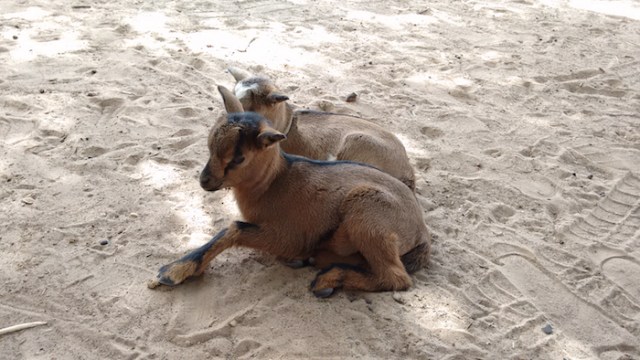
Also, baby goats.

baby_goats

I just realized that most of what strikes me as notable and shareable during my travels is food-related. It is such a huge part of culture, no?

On that note, if the Internet cooperates, tomorrow I’ll post pictures of the delicious Senegalese Easter concoction I tried yesterday after it was mass-produced in my house (during a serious two days-long all-hands-on-deck operation).